Should You Use Open-Source LLMs for Your Product? Cost, Control, and the Chinese-Model Question
Open-weight models got genuinely good in 2026, and a lot of the best are now Chinese. Here's a practical way to decide whether open or closed models fit your product, weighing cost, control, data residency, and the things people get wrong about both.
Usman Akram · · 4 min read
A couple of years ago, "use an open-source model" was code for "we're on a budget and willing to accept worse results." In 2026 that's just wrong, and clinging to the old assumption will lead you to a bad decision. Open-weight models got genuinely good, the best of them are competitive for a lot of real work, and choosing between open and closed is now a real strategic question rather than a quality compromise.
It also got more interesting, because a lot of the strongest open models now come from somewhere people didn't expect.
What changed, and who's actually leading
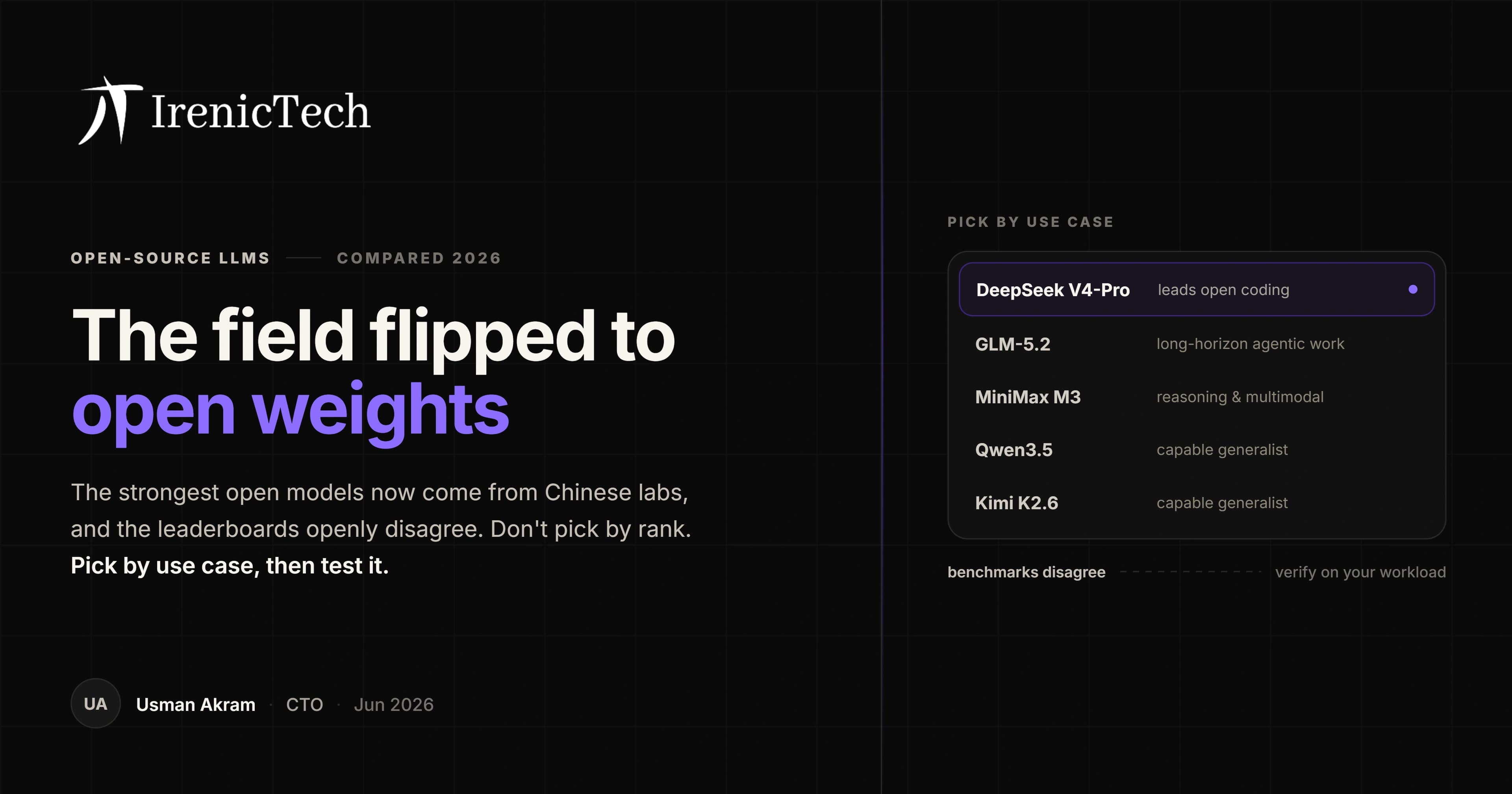
The short version: the open-weight field stopped being an afterthought. Several of the most capable open models today come from Chinese labs, names like Z.ai with its GLM series, DeepSeek, Alibaba's Qwen, and Moonshot's Kimi, and they trade places near the top of the open leaderboards constantly. The era when one Western model obviously led the open field is over.
Two practical notes before you act on that. First, many of these models ship under permissive licenses, which means you can genuinely build on them rather than just look. Second, the rankings move week to week, so don't anchor on whichever model is "best" the day you read this. Treat any leaderboard as a snapshot, and test the actual model against your actual task before committing. The headline isn't "model X won." It's "open is now a serious option, and you have to evaluate it for yourself."
The real reason to choose open isn't cost
People reach for open models expecting to save money, and sometimes they do. But cost is the least interesting reason, and if it's your only reason you'll probably be disappointed once you account for the work of running the thing.
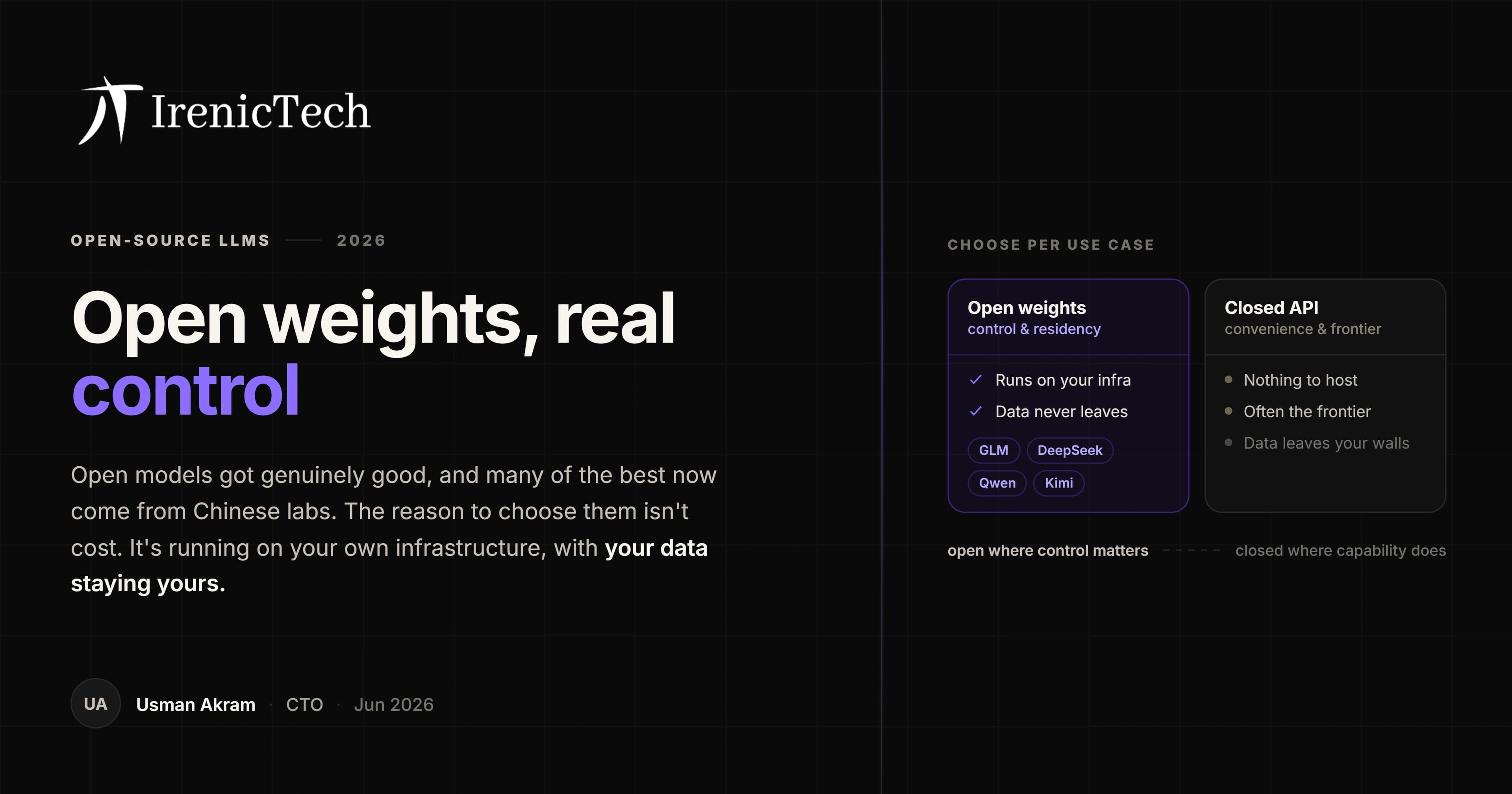
The reason that actually matters is control. When you use a closed model, you send your data to someone else's servers, you pay whatever they decide to charge, and you live with their roadmap, their rate limits, and their occasional deprecations. When you run an open-weight model, you decide where it runs, your data stays in an environment you control, and no vendor can change the terms underneath you. For a lot of businesses, that independence is worth more than any per-token saving.
Data residency, and why the Gulf cares more than most
Control turns from nice-to-have into non-negotiable the moment data residency enters the picture. Plenty of industries and regions have firm rules about where data can physically live and who can touch it. Regulated sectors everywhere feel this, and much of the Gulf in particular takes data sovereignty seriously, both in regulation and in preference.
A closed API model means your data goes to the provider's infrastructure, wherever that is, every time you make a call. A self-hosted open model means the data never leaves your environment at all. For a healthcare, finance, or government-adjacent product, or any company operating where the rules are strict, that distinction can decide the entire architecture. This is one of the clearest cases where open isn't the cheaper choice, it's the only viable one.
It also quietly answers the "is it safe to use a Chinese model" question that makes people nervous. The weights are just files you run yourself. When you self-host, you aren't sending anything back to the lab that made the model, so the data-sharing fear mostly evaporates. The reasonable diligence is the same as for any model: check the license, evaluate the quality, apply your normal governance.
Where closed models still earn their place
None of this means open wins by default, and pretending it does is its own mistake. Closed models are genuinely easier. Someone else runs the infrastructure, keeps it patched, and hands you a reliable API, which is a real and ongoing saving of effort. At the very frontier of capability, the closed labs are often still ahead, so for the hardest tasks where you need the absolute best, the closed option can be the right call.
And running an open model yourself is real work. You take on hosting, scaling, monitoring, and maintenance, and that operational weight is exactly what the closed API was saving you. If you don't have anyone to own that, the convenience of closed may be worth more to you than the control of open. Be honest about which you actually have.
So how do you choose
Like most of these decisions, it's per use case, not a one-time religious commitment, and the build versus buy logic maps onto it almost exactly. Lean open when control and data residency are the priority, when you need to run on your own infrastructure, or when independence from a single vendor matters for the long run. Lean closed when convenience and absolute frontier capability matter most and the data is less sensitive.
A lot of real products end up using both: an open model self-hosted for the parts that touch sensitive data, and a closed API for the parts that need maximum capability and aren't constrained. That's not indecision, it's just matching the tool to the job, and it's usually the most pragmatic architecture. Whichever way you lean, protecting the data the model touches is the constant, which is the same discipline behind shipping AI-built apps without the breach.
If you're weighing open against closed for a real product and want a recommendation grounded in your actual constraints rather than this month's leaderboard, that's the conversation we have with clients on our AI-native engineering service. Tell us what you're building, where your data has to live, and book a discovery call, and we'll give you a straight answer for your case.
Frequently asked
Are open-source LLMs good enough to use in production in 2026?
For many real use cases, yes. Open-weight models improved dramatically and several of the strongest now come from Chinese labs such as Z.ai (GLM), DeepSeek, Alibaba (Qwen), and Moonshot (Kimi). They are genuinely capable for a wide range of tasks like coding, reasoning, and long-context work. The frontier of absolute capability is still contested, so the honest answer is that open models are good enough for most products, and you should test the specific model against your specific task rather than trusting a leaderboard.
What's the difference between open-source and closed LLMs?
A closed model, like those from the big commercial labs, is accessed through an API you don't control; you send data to the provider and pay per use. An open-weight model is one whose weights you can download and run yourself, on your own infrastructure or a host you choose. The practical differences are control and data residency: with open weights you decide where the model runs and where your data goes, while with closed models you trade that control for convenience and, often, frontier capability.
Why would a business self-host an open-source LLM?
Mainly for control and data residency. Self-hosting an open-weight model means your data never has to leave your environment, which matters for regulated industries and regions with strict data rules, including much of the Gulf. It also removes dependence on a single vendor's pricing and availability, and can be more cost-predictable at scale. The trade is that you take on the operational work of running and maintaining the model, which is real and shouldn't be underestimated.
Is it safe to use Chinese open-source AI models?
The weights themselves are just files you can run in your own environment, and many are released under permissive open licenses, so you are not sending data to the lab that made them when you self-host. The sensible concerns are the same as for any model: evaluate it for your use case, understand the license terms, and apply your normal data governance. Self-hosting actually sidesteps the data-sharing worry, because the model runs on infrastructure you control rather than calling back to anyone.
CTO, IrenicTech
Usman is the CTO of IrenicTech. He builds AI agents, RAG systems, and automations into web and mobile products, and gets them shipped in weeks instead of quarters. He's focused on AI that learns from the people using it, and that's secure enough to trust with real data.
Connect on LinkedIn