Build vs Buy AI in 2026: When to Use an Off-the-Shelf Agent and When to Build Your Own
Most companies don't need to build AI from scratch, and some can't afford not to. Here's a clear-eyed framework for deciding when an off-the-shelf agent is enough and when a custom build is the only thing that actually fits.
Usman Akram · · 4 min read
Every business we talk to in 2026 has landed on the same question from a different direction: there's an AI tool for almost everything now, so when does it make sense to buy one, and when do you build your own? It's the right question. It's also one that vendors and agencies both have an incentive to answer dishonestly, so let me try to do it straight.
The short answer
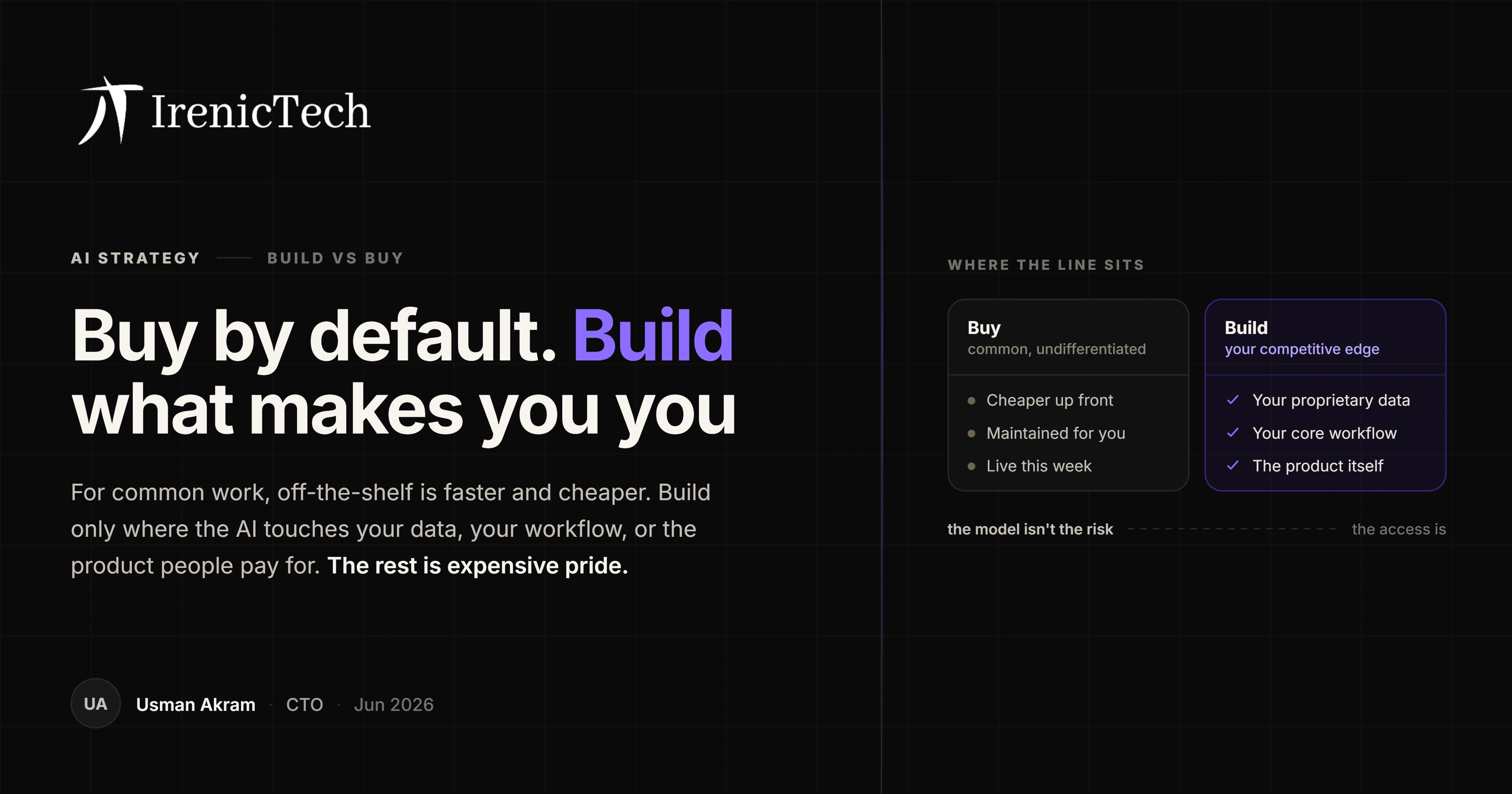
Buy by default. Build where it counts. Most of what AI does for a business, summarizing, drafting, answering common questions, moving data around, is not where your company wins or loses, and there's a perfectly good tool for it already. Pay for that tool and move on. Save the building for the handful of places where a generic tool would quietly file down the exact thing that makes you competitive.
That's the whole framework. The rest of this is how to tell the two apart, because in the moment it's rarely obvious.
Why "just buy it" is usually right
It feels sophisticated to build your own. It usually isn't. An off-the-shelf tool is live today, costs a subscription instead of a project, and someone else stays up at night keeping it patched and current as the models change underneath it. For anything common and undifferentiated, that's an easy trade, and rebuilding it in-house is mostly expensive pride wearing the costume of strategy.
There's a reason adoption is tilting this way. The market is flooded with capable products, and for a lot of everyday work, buying gets you 90% of the value at 10% of the effort. Starting from "what can we buy" instead of "what can we build" will save most companies a great deal of money and a few painful quarters.
When buying quietly costs you
Here's where the default breaks. The moment the AI has to touch the thing that actually makes you you, a generic tool starts working against you.
Three signals that you're in build territory:
- It needs your proprietary data. If the value comes from your own data, your history, your domain, your customers, an off-the-shelf model that's never seen any of it can only ever be generic. The differentiation is in the data, and a tool that can't reach it can't deliver it.
- It sits inside your core workflow. When the AI is doing the specific thing your business is built around, not a side task, a tool that's "close enough" means you bend your operation to fit the software instead of the other way around. Over time that tax compounds.
- It's part of the product you sell. If the AI feature is something your customers pay for, you can't rent your differentiation from a vendor every competitor can also subscribe to. That's the one place where building isn't optional, it's the point.
If none of those apply, buy. If one of them does, building, or building a custom layer on top of what you buy, usually pays for itself in ways the subscription never could.
The part everyone underestimates: it's not the model, it's the access
Whichever way you go, the risk that should keep you up isn't whether the AI is smart enough. It's what it's allowed to touch. An agent wired into your systems with broad permissions and thin oversight is a liability sitting one confused instruction away from a bad day. Gartner expects roughly a quarter of enterprise breaches to involve AI agent abuse by 2028, and we've watched the cleanup on enough projects to take that seriously, which is the whole reason we wrote about shipping AI-built apps without the breach.
This cuts against a lazy version of "just buy it." A bought tool with deep access to your data is still your risk to manage, not the vendor's. And a custom build done properly, with least-privilege access, audit logs, and a human in the loop, can be the safer option precisely because you control the boundaries. Security isn't a point in favour of buying or building. It's a tax both options owe.
The middle path most people miss
The framing "build or buy" hides the option that's often best: buy the infrastructure, build the thin layer that makes it yours. You don't rebuild what a mature platform already does well. You build the narrow custom piece that connects those tools to your specific workflow and your specific data, and nothing more.
That's most of the AI work worth doing in 2026, and it's deliberately unglamorous. It's also how you get a custom experience where it matters without paying to reinvent the parts that are already solved. The trick is being honest about which parts those are.
How to decide, quickly
Ask one question about the use case in front of you: does this touch what makes us competitive? If the answer is no, buy the best tool you can find and don't look back. If the answer is yes, you're looking at a build, and the next question is whether it's a full custom system or a lean layer on top of tools you already pay for, which is the cheaper answer more often than people expect. And remember the honest state of the technology: even the best agents in 2026 are supervised collaborators, so design for a human in the loop from the start whichever path you choose.
If you're staring at that decision for a real project and want a recommendation that isn't trying to sell you the most expensive option, that's exactly the conversation we have with clients on our AI-native engineering service. Tell us what you're weighing and book a discovery call, and we'll give you a straight answer for your case.
Frequently asked
Should I build or buy AI for my business?
Buy when the task is common and not a source of competitive advantage, because an off-the-shelf tool will be cheaper, faster, and maintained for you. Build when the AI needs to work with your proprietary data, sit inside a workflow that is core to your business, or power the product your customers actually pay for. Many companies end up doing both: buying for general productivity and building for the few things that genuinely differentiate them.
Is it cheaper to buy an off-the-shelf AI tool than to build one?
Up front, almost always yes. A subscription tool has no development cost and someone else handles maintenance and model updates. Building costs more to start. The calculation changes when the tool can't do exactly what you need, when per-seat pricing scales painfully, or when the workflow is so central that owning it outright is worth the investment. The honest answer depends on how specific and how strategic the use case is.
What are the risks of building custom AI in-house?
The main risks are cost, time, and security. Custom builds take longer and need real engineering to do well, and an AI agent connected to your systems is a genuine security surface if it's over-privileged or unsupervised. Industry analysts expect AI agent abuse to be behind a meaningful share of enterprise breaches by 2028. A good build mitigates this with least-privilege access, audit logging, and human review, but it has to be designed in, not bolted on.
Can you build AI on top of tools we already pay for?
Often, yes, and it's frequently the smartest path. Rather than rebuilding what an existing platform already does well, you build the thin custom layer that connects those tools to your specific workflow and data. You get the leverage of off-the-shelf infrastructure with a custom experience where it actually matters, usually faster and cheaper than building everything from scratch.
CTO, IrenicTech
Usman is the CTO of IrenicTech. He builds AI agents, RAG systems, and automations into web and mobile products, and gets them shipped in weeks instead of quarters. He's focused on AI that learns from the people using it, and that's secure enough to trust with real data.
Connect on LinkedIn