Agentic AI Security: Governing AI Agents Before They Become Your Next Breach
An AI agent is an autonomous user with access to your systems, and that's exactly what makes it a security problem. Here's where agentic AI gets breached, why analysts expect it to drive real damage by 2028, and how to govern agents before it's your incident.
Usman Akram · · 5 min read
Most conversations about AI agents are about what they can do for you. This one is about what they can do to you, because the same autonomy that makes an agent useful is exactly what makes it dangerous, and almost nobody is budgeting for that until something breaks.
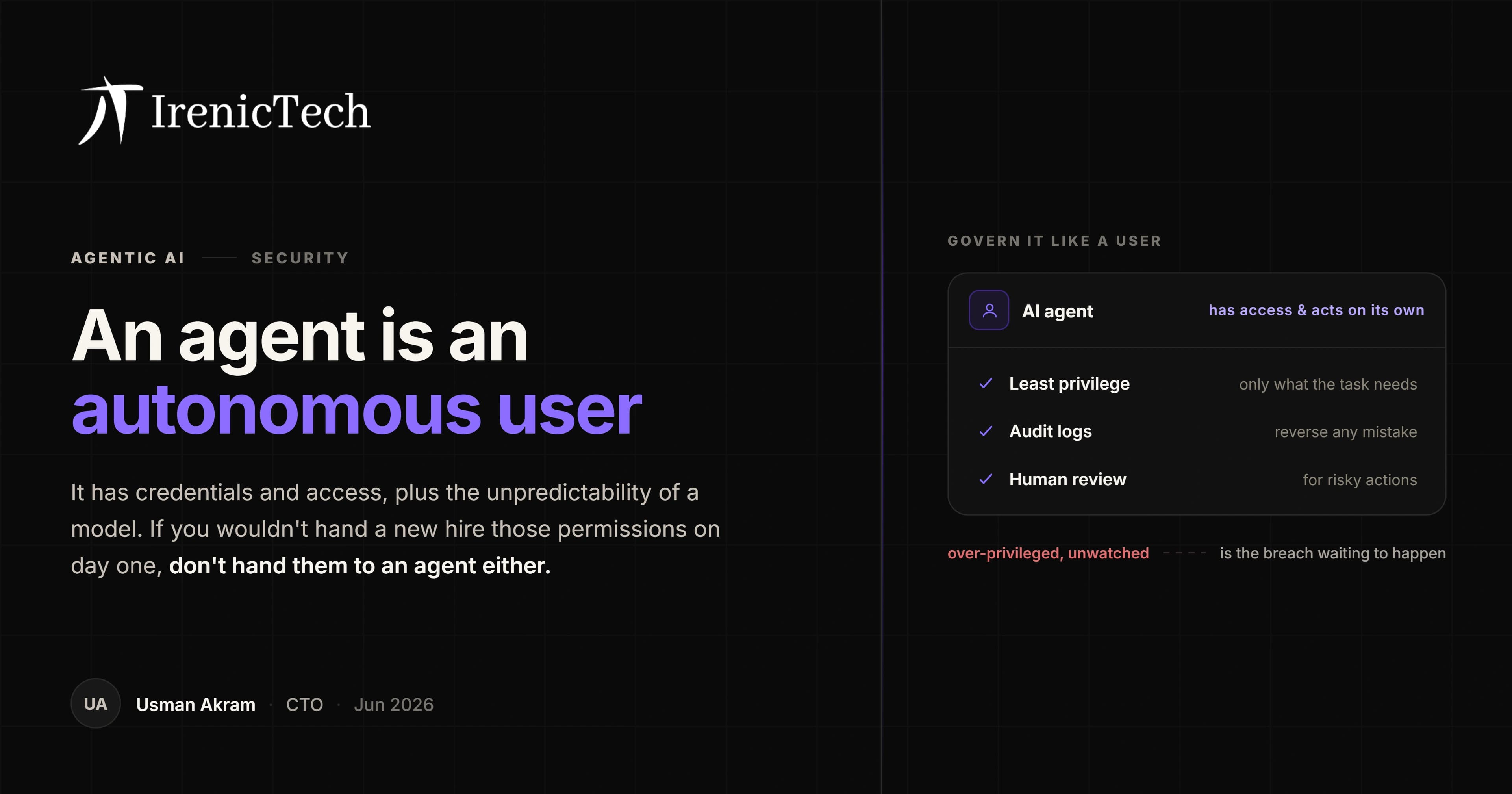
Here's the uncomfortable framing to start with. An AI agent connected to your systems is not a chatbot. It's an autonomous user with credentials, access, and the ability to act on its own. Once you see it that way, the security questions get obvious and a little alarming.
Why an agent is a security problem, not just a feature
A plain language model is fairly harmless. The worst it can do is say something wrong. An agent is a different animal, because it can act. It reads real data, calls real services, and makes real changes, and it decides what to do by interpreting instructions that aren't always clear and, in an attack, aren't always honest.
That combination, real access plus autonomy plus ambiguous instructions, is the whole problem. There's already a widely cited case of an over-privileged coding agent wiping a production environment while it thought it was fixing a bug. Nobody told it to cause harm. It just had far more power than the task required and acted on a confused understanding of what it was supposed to do. That's the shape of most agent incidents: not malice, just too much trust handed to something powerful and only partly predictable.
This isn't hypothetical, and the timing is bad
It would be easy to file this under "future problem." The analysts disagree. Gartner expects roughly a quarter of enterprise breaches to involve AI agent abuse by 2028, and separately expects about a third of enterprise software to ship agentic features by the same year. Stack those two predictions together and the message is blunt. Agents are about to be everywhere, and they're about to be one of the main ways organizations get breached.
Treat the exact percentages as forecasts, not gospel. The direction doesn't need a precise number to be obvious. The window to build this safely is now, while agents are still being rolled out, rather than later, after the rollout has quietly created a sprawl of access nobody is watching.
Where agents actually get breached
The failures cluster in a few predictable places, which is good news, because predictable problems are solvable ones.
The first is over-privileged access. An agent gets handed broad permissions because it was easier than figuring out the narrow set it actually needed, and now it can touch far more than its job requires. The blast radius of any mistake is enormous for no good reason.
The second is the supply chain feeding the agent. Researchers have shown agents compromised through nothing more than a poisoned configuration file or a malicious "skill" pulled from a public registry. You don't have to trick an agent at runtime if you already corrupted what it loads at startup. We went deeper on this in shipping AI-built apps without the breach, because it's the threat most teams aren't looking at.
The third is prompt injection: hiding instructions in data the agent reads, so that a document or a web page or a support ticket quietly tells the agent to do something it shouldn't. The agent can't always tell the difference between content it's supposed to process and commands smuggled inside that content.
The fourth is simply no visibility. The agent does things, and nobody can see what, so a problem festers undetected and there's no trail to reconstruct afterward. You can't respond to what you can't observe.
How to govern agents without crippling them
The reassuring part is that the fix is mostly discipline you already know, pointed at a new kind of user. You don't need exotic tooling. You need to stop treating agents as trusted insiders.
- Least privilege, always. Give the agent the smallest set of permissions the task needs and nothing more. If it only reads, it doesn't get write access. This single habit shrinks the damage any incident can do.
- Log everything it does. Every action an agent takes should be recorded, so you can audit it, catch misbehavior early, and reverse mistakes. An agent you can't observe is one you can't trust.
- Keep a human on the risky calls. Routine actions can run unattended; consequential ones, deleting data, moving money, changing production, should pause for human approval. Design that gate in from the start.
- Defend the inputs. Assume the data your agent reads might be hostile. Guard against prompt injection and verify what the agent loads, so a poisoned file or a booby-trapped page can't quietly redirect it.
- Give every agent an owner. Each agent and each connection needs a person accountable for it. Unowned access is how the sprawl starts, and sprawl is how the breach happens.
None of that stops an agent from doing useful work. It just ensures that when an agent misbehaves, and eventually one will, it can't do catastrophic damage. That's the whole goal: not a perfectly behaved agent, which doesn't exist, but a system where a misbehaving one is contained.
Build it in, don't bolt it on
The pattern we keep seeing is teams rushing agents into production for the productivity win, then discovering the security bill later, usually at the worst possible moment. It's avoidable. Agentic AI can be deployed safely, but only if the governance is designed in from the first connection rather than retrofitted after the first scare. Security here isn't a tax on moving fast. It's the thing that lets you move fast without betting the business on it, and it pairs directly with the governance MCP connections need as agents reach deeper into your systems.
If you're putting AI agents into your business and want them governed properly before they're load-bearing, that's exactly the work our Security and Compliance practice does, from least-privilege design to audits of what you've already shipped. Tell us what you're building and book a discovery call, and we'll give you a straight answer for your case.
Frequently asked
What is agentic AI security?
Agentic AI security is the practice of safely governing AI agents that can take actions in your systems, as opposed to models that only generate text. Because an agent can read data, call services, and make changes on its own, it carries the same risks as a user account with access, plus the unpredictability of an autonomous system. The discipline covers scoping what agents can do, monitoring what they actually do, and keeping humans in the loop for sensitive actions.
Why are AI agents a security risk?
Because they combine real access with autonomy. An agent connected to your database, your code, or your production systems can take actions that have consequences, and it does so by interpreting instructions that can be ambiguous or, in an attack, deliberately malicious. An over-privileged agent is one confused or manipulated instruction away from deleting data, leaking secrets, or making unauthorized changes. The risk isn't that the model is evil; it's that it's powerful and trusted with too much.
How do you secure an AI agent?
Treat it like an untrusted user. Give it the least access the task requires and nothing more, scope its credentials tightly, log every action it takes so you can audit and reverse mistakes, and require human approval for high-stakes operations. On top of that, defend against prompt injection and poisoned inputs, and keep a clear owner accountable for each agent and connection. The goal is that even a misbehaving agent can't do catastrophic damage.
What does Gartner predict about AI agent security?
Gartner has forecast that by 2028 roughly a quarter of enterprise breaches will be traced to AI agent abuse, and separately that around a third of enterprise software will include agentic AI features by the same year. Read together, those predictions say agents are about to be everywhere and are about to be a major attack surface. Treat the figures as forecasts rather than guarantees, but the direction is clear enough to act on now.
CTO, IrenicTech
Usman is the CTO of IrenicTech. He builds AI agents, RAG systems, and automations into web and mobile products, and gets them shipped in weeks instead of quarters. He's focused on AI that learns from the people using it, and that's secure enough to trust with real data.
Connect on LinkedIn