MCP Explained: The Protocol That Makes AI Agents Useful, and How to Govern It
MCP is the standard that lets AI agents actually use your tools and data instead of just talking about them. Here's what it is, why it took over in 2026, and why connecting agents to your systems is now a governance problem too.
Usman Akram · · 4 min read
If you've spent any time around AI agents in the last year, you've run into three letters over and over: MCP. It shows up in product announcements, job posts, and vendor pitches, usually without anyone stopping to explain what it actually is or why it suddenly matters. So let's fix that, because once it clicks, a lot of the agentic AI conversation stops sounding like noise.
The short version
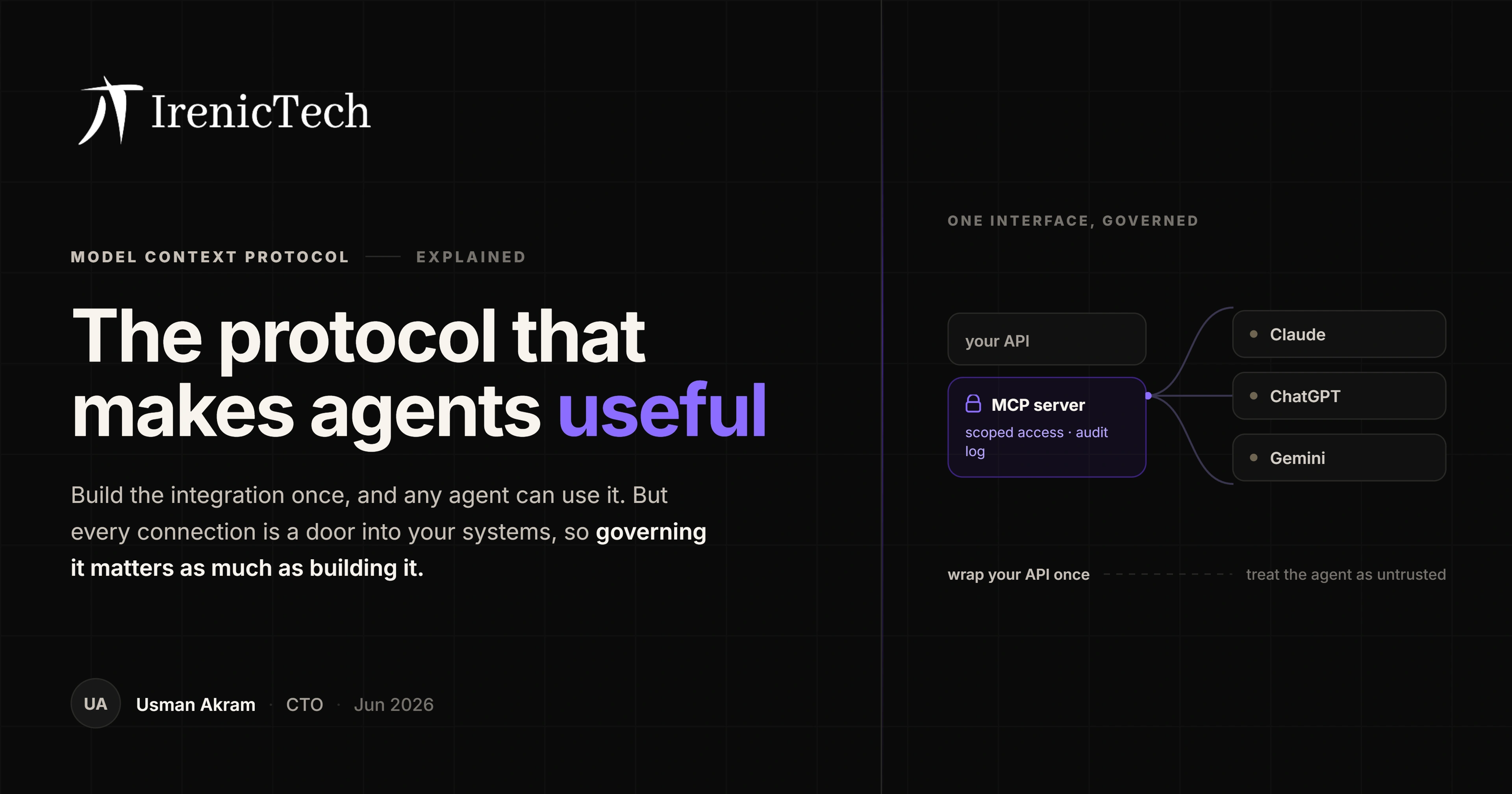
MCP, the Model Context Protocol, is a standard way for AI agents to connect to your tools and data. That's it. Before it existed, hooking a model up to your database or your CRM or your internal services meant writing custom code for that specific model and that specific tool, every single time. MCP replaces all of that with one common interface. You expose what your system can do once, and any agent that speaks MCP can use it.
If that sounds unglamorous, good. The most important plumbing usually is.
Why this is a bigger deal than it sounds
Here's the thing people miss. A language model, on its own, can't do anything. It can write you a beautiful paragraph about booking a flight, but it can't book the flight. The entire value of an agent comes from connecting it to real tools, and that connection was, until recently, a nightmare of one-off integrations.
Picture the old way. You want your agent to read from your database, post to Slack, and update a ticket. That's three custom integrations. Now you switch from one model to another, and you may be rebuilding all three. Multiply that across a real company with dozens of tools and a few different AI products, and the integration work alone could sink the project before it delivered anything.
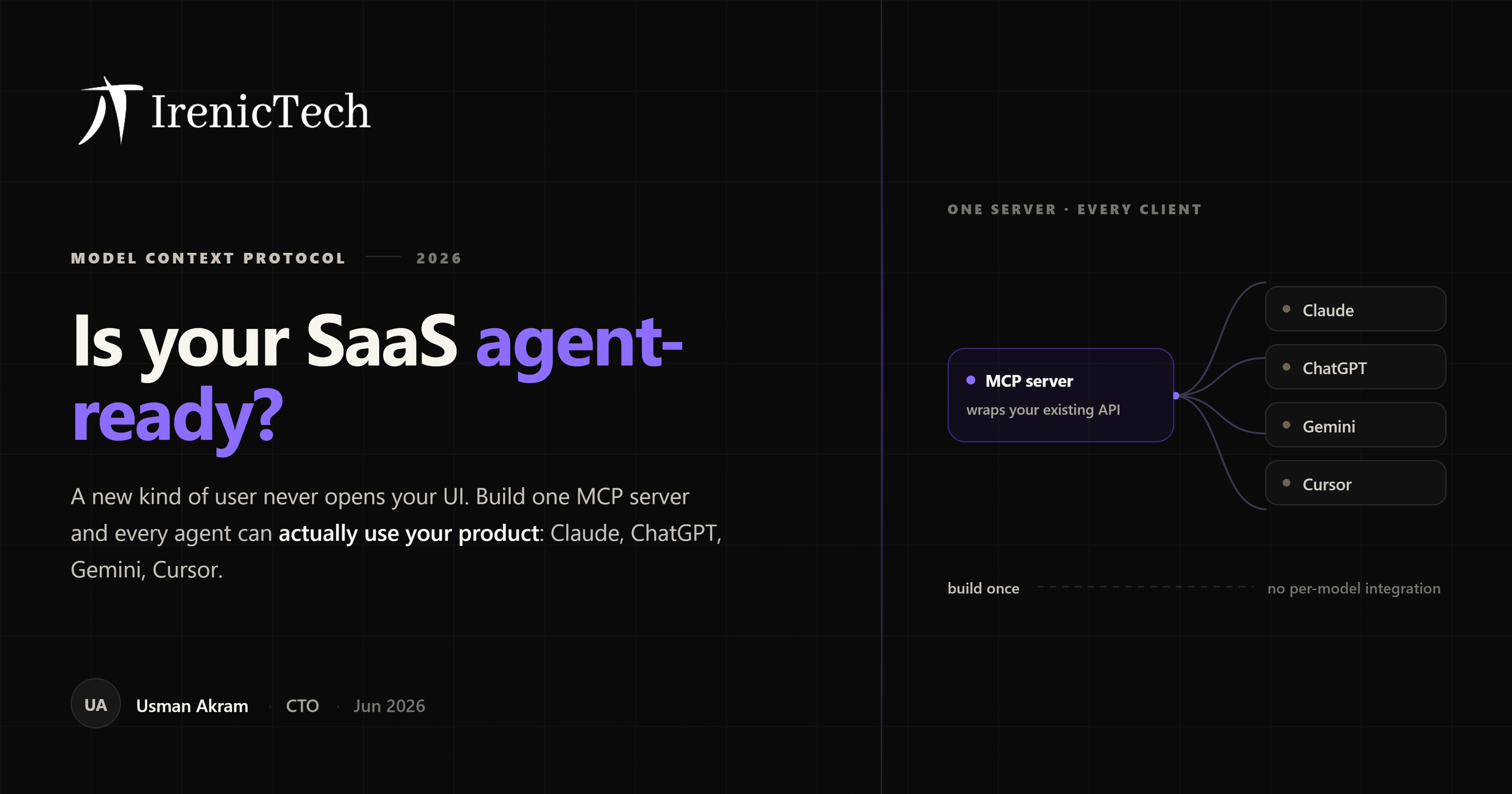
MCP collapses that. Build an MCP connection for your tool once, and it works with Claude, ChatGPT, Gemini, Cursor, and whatever comes next. That portability is exactly why 2026 was the year agents went from impressive demos to things businesses could actually deploy. The models were already good enough. What was missing was a sane way to plug them in.
Why it became the standard, and not just one option
Plenty of clever standards die in obscurity. MCP didn't, and the reason is worth noting. Anthropic introduced it in late 2024 and then did the thing that actually builds a standard: opened it up. By the end of 2025 it had been handed to the Linux Foundation to steward, and the other major AI providers had adopted it rather than fighting it with rivals of their own.
That matters because a connection standard is only useful if everyone agrees to it. A protocol that only worked with one company's models would just be another piece of lock-in. The fact that the whole industry coalesced around MCP is what makes building on it a safe bet rather than a gamble on one vendor's roadmap.
The part that gets skipped: governance
Now the uncomfortable half. Every MCP connection you create is a door into your systems, and doors are exactly as safe as the locks you put on them.
When a company wires up one or two connections, nobody worries. When it wires up dozens, often added by different teams in a hurry, you get a sprawl of access that nobody is tracking. Which agents can reach the customer database? Who approved that connection to the payments system? When an agent does something it shouldn't, can you even see it happened? Those questions stop being hypothetical fast.
The teams handling this well treat MCP connections the way a sensible company treats any privileged access. Every connection has an owner. Agents get the least access the task needs and nothing more. Everything an agent does gets logged. And new connections go through a registry or a review, not a quiet commit on a Friday afternoon. None of this is exotic security work. It's the same discipline you'd apply to a new employee or a third-party vendor, pointed at a new kind of user that happens to be software.
What this means if you're building
Two practical takeaways. First, if you're putting AI agents into your business, MCP is almost certainly the layer you'll connect them through, so it's worth understanding rather than treating as someone else's acronym. Building it usually means wrapping the APIs you already have, which is far less work than it sounds, and it's a big part of what we mean when we talk about making a product agent-ready.
Second, the connection is the easy part. The governance is what separates a useful agent from a liability, and it's the part that gets rushed. An agent with broad, unsupervised access to your systems is the same risk we keep flagging in agentic AI security: one confused instruction away from a bad day. Build the guardrails in from the first connection, not after the first incident.
If you're trying to connect agents to your systems and want it done in a way you won't regret later, that's the kind of work we do on our AI-native engineering service. Tell us what you're building and book a discovery call, and we'll give you a straight answer for your case.
Frequently asked
What is MCP (Model Context Protocol)?
MCP is an open standard, introduced by Anthropic in late 2024 and now stewarded by the Linux Foundation, that defines how AI agents connect to external tools, data, and services. Instead of writing a custom integration for every model and every tool, you expose your capabilities through one MCP interface that any compatible agent can understand and use. It is the layer that lets an AI model actually act inside your systems rather than just describe what it would do.
Why do AI agents need MCP?
Because a model on its own can only produce text. To be useful in a business it has to read real data, call real services, and take real actions, and that means connecting to your tools. Before MCP, every one of those connections was bespoke glue code. MCP standardizes the connection, so the same tool works across Claude, ChatGPT, Gemini, and other agents without rebuilding the integration each time.
Is MCP a security risk?
MCP itself is just a protocol, but every connection you create with it is a path into your systems, so it has to be governed. The real risks are over-privileged agents that can do more than the task requires, and unmanaged connections nobody is tracking. The fix is the same as for any sensitive access: scoped permissions, least privilege, audit logging, and a clear owner for each connection. Treat the agent like an untrusted user, because effectively it is one.
Do we need MCP if we already have an API?
Usually you build MCP on top of the API you already have rather than replacing it. An API tells a developer how to call your system; an MCP server tells an agent what your system can do and how to use it safely, with the descriptions and permissions an autonomous model needs. The MCP server typically wraps your existing endpoints, so you reuse the work you've already done.
CTO, IrenicTech
Usman is the CTO of IrenicTech. He builds AI agents, RAG systems, and automations into web and mobile products, and gets them shipped in weeks instead of quarters. He's focused on AI that learns from the people using it, and that's secure enough to trust with real data.
Connect on LinkedIn