Is Your SaaS Agent-Ready? Why MCP Is the Integration You Can't Skip in 2026
AI agents are starting to choose and use software on their own. The SaaS that exposes an MCP server becomes the one they can actually use, and that's the integration winning enterprise deals in 2026.
Usman Akram · · 4 min read
There's a new kind of user showing up to your product, and it never opens your UI. It's an AI agent, and increasingly it's the thing deciding which software to use and then using it. The products an agent can actually operate are the ones that get picked. In 2026 that capability finally has a name and a standard behind it: being agent-ready through the Model Context Protocol, or MCP.
What does "agent-ready" actually mean?
Strip it down and agent-ready means one thing: an agent can work out what your product does and then do it, safely, without a person driving the screen. Three pieces make that possible. The agent needs a description of your capabilities it can reason about. It needs to authenticate as a constrained user rather than a superuser. And it needs a structured way to take an action and read back what happened. MCP hands you all three in one place.
Why care now? Because the buyer is quietly changing. Enterprises are wiring agents into the workflows that used to be all clicks and copy-paste, and those agents gravitate toward tools that speak a standard they already know. If an agent can't operate your product, it routes around you to one it can.
What is MCP, and why did it win?
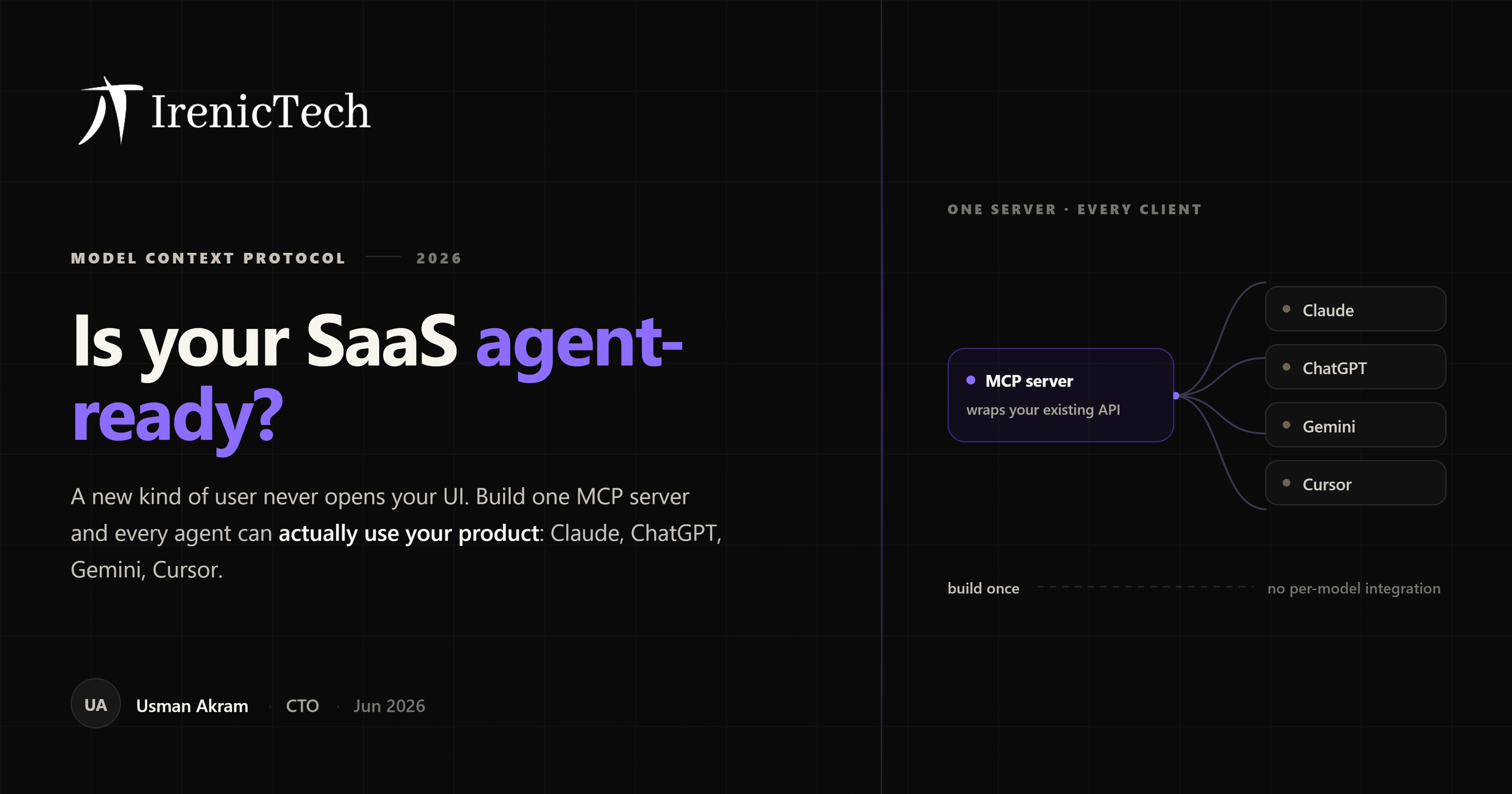
MCP is an open standard for connecting AI models to outside tools and data without hand-building a separate integration for every model-and-service pair. Think of it as collapsing an N×M mess into hub-and-spoke. You build one MCP server for your product and it works with Claude, ChatGPT, Gemini, Cursor, and whatever client ships next.
The adoption story is the part worth paying attention to. Anthropic introduced it, and within months OpenAI, Google DeepMind, and Microsoft had all adopted it too. By early 2026, Anthropic reported more than 10,000 active public MCP servers and roughly 97 million monthly SDK downloads, and the protocol had been donated to a Linux Foundation organization so no single vendor owns it. Standards fights usually drag on for years. This one didn't, which is rare enough to be worth betting on.
Isn't our REST API enough?
Your REST API and an MCP server answer two different questions. The API explains how a developer calls you. An MCP server explains, to a model, what you can do and when doing it makes sense, with the tool names, input schemas, and auth an agent needs to act on its own without a human in the loop.
Here's the reassuring part: the MCP server usually just wraps the API you already have. You're not rebuilding the backend. You're publishing a version of it an agent can read. Skip that, and anyone integrating an agent with your product has to hand-wire it themselves, which is exactly the friction the standard exists to kill.
The part teams underestimate: an agent is an untrusted user
An agent loose in your product is a user that moves fast and can be talked into things, whether by a prompt injection, a booby-trapped document, or just a confused instruction. So we build the agent interface like any other security boundary. Scoped tokens instead of a master key. Least privilege on every tool. Logs on every action. The rule we hold to is boring and non-negotiable: an agent can do exactly what its task needs, and nothing past that.
It's the same stance we take everywhere else, the one behind shipping AI products in weeks, which is to treat AI like untrusted code. Agent-ready isn't a single endpoint you bolt on. It's a security model. Get it wrong and you haven't made your product agent-ready, you've made it breach-ready.
How to get agent-ready without boiling the ocean
Don't try to expose your whole surface on day one. We've found it works better to pick the handful of actions agents will really reach for, the high-value reads and the writes that matter, and ship an MCP server that does those few things well, with tight auth and real observability around them. Then you widen it once actual usage tells you where the gaps are.
That's the everyday work of our AI Native and SaaS Platforms practices: take a product with a decent API and turn it into something an agent can drive safely, in weeks rather than quarters. The SaaS that gets agent-ready in 2026 is the one still on the shortlist when the buyer doing the evaluating isn't a person.
Not sure whether your product is ready for that shift? Let's talk. We'll map the shortest route from the API you have today to a secure MCP server an agent can actually use.
Frequently asked
What does it mean for a SaaS product to be agent-ready?
Agent-ready means an AI agent can discover what your product does and use it safely without a human clicking through the UI. In practice that means exposing your core actions through the Model Context Protocol (MCP), with scoped authentication and clear tool descriptions, so an agent can read, act, and report back inside your product.
What is MCP (Model Context Protocol)?
MCP is an open standard, originally from Anthropic and now governed under the Linux Foundation, that lets AI models connect to external tools and data through one consistent interface. Build one MCP server for your product and it works with every MCP-compatible client, including Claude, ChatGPT, Gemini, and Cursor, instead of a custom integration per model.
We already have a REST API. Do we still need an MCP server?
Usually yes. A REST API tells a developer how to call you; an MCP server tells an agent what you can do and when to do it, with the tool descriptions, schemas, and auth an autonomous model needs to act correctly. The MCP server typically wraps your existing API rather than replacing it.
How long does it take to make a SaaS agent-ready?
For a product with a clean API, a focused MCP server covering your highest-value actions is usually a matter of weeks, not quarters. We scope it to the few workflows agents will actually use, ship that, secure it, and expand from there.
CTO, IrenicTech
Usman is the CTO of IrenicTech. He builds AI agents, RAG systems, and automations into web and mobile products, and gets them shipped in weeks instead of quarters. He's focused on AI that learns from the people using it, and that's secure enough to trust with real data.
Connect on LinkedIn