AI-Native Vertical SaaS: Building One That Survives Its First Enterprise Deal
AI-native vertical SaaS startups are reaching $100M ARR faster than any prior generation. Here's what separates a real AI-native product from AI bolted onto a CRUD app, and how to build one that survives its first enterprise deal.
Usman Akram · · 3 min read
The fastest-growing software companies of 2026 aren't bolting AI onto a product. The product is the AI. AI-native vertical SaaS startups are hitting $100M ARR faster than any earlier generation of SaaS, and the way they're doing it is by owning one industry's workflow from end to end. The catch is that the same velocity that gets you to a jaw-dropping demo is what tends to sink you at the first serious enterprise security review. Surviving both is the whole game.
What makes a SaaS "AI-native" — and not just AI-flavored?
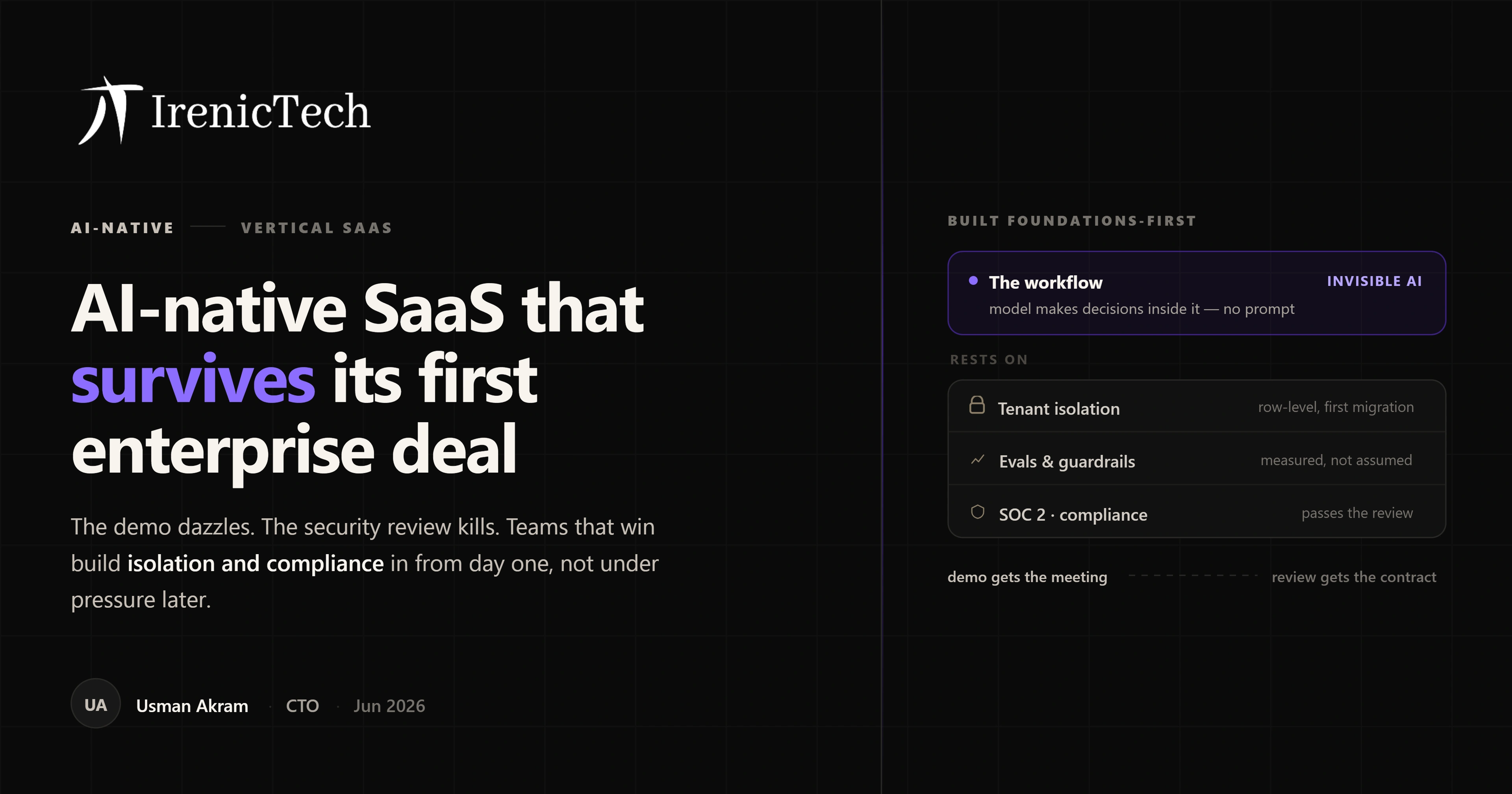
Simple test: pull the AI out, and does the product still stand? If it does, the AI was a feature. AI-enhanced SaaS has a chatbot in the corner and a summarize button, and the app works the same with or without them. AI-native SaaS collapses without the model, because the model is doing real work in the middle of the workflow, often where nobody even sees it happen.
The market has clearly picked a side. The phrase doing the rounds in 2026 is "invisible AI," meaning systems that sit inside existing workflows and make calls without anyone typing a prompt, and that's where the money is flowing. According to the SaaS Management Index, spending on AI-native applications, the ones where AI is core rather than garnish, jumped 75% year over year, and those startups are growing as much as three times faster than their traditional SaaS peers at every revenue band.
Why vertical is winning
Horizontal platforms sell to everybody and end up owning nobody's actual workflow. Vertical products do the opposite. They own a whole industry process, plus the proprietary data that piles up alongside it, and that compounds into outcomes a general-purpose tool can't touch. The 2026 projections have vertical SaaS taking something like 60% of new market growth, with the category climbing toward $720 billion by 2028.
It shows up most clearly in industries with deep, regulated, painful workflows. Healthcare, legal, housing. Owning both the workflow and the AI outcome on top of it has turned out to be the most capital-efficient way anyone's found to scale. You don't take those markets with a nicer dashboard. You take them by doing work the customer used to do by hand.
The trap: a great demo that dies at the enterprise security review
This is where a lot of AI-native startups quietly stall out. The demo dazzles, the pilot goes well, and then a real enterprise asks the unglamorous questions. How is our data isolated from everyone else's? Where are your evals? Are you SOC 2 ready? If the answer to those is some version of "that's on the roadmap," the deal that was supposed to make the company stalls instead.
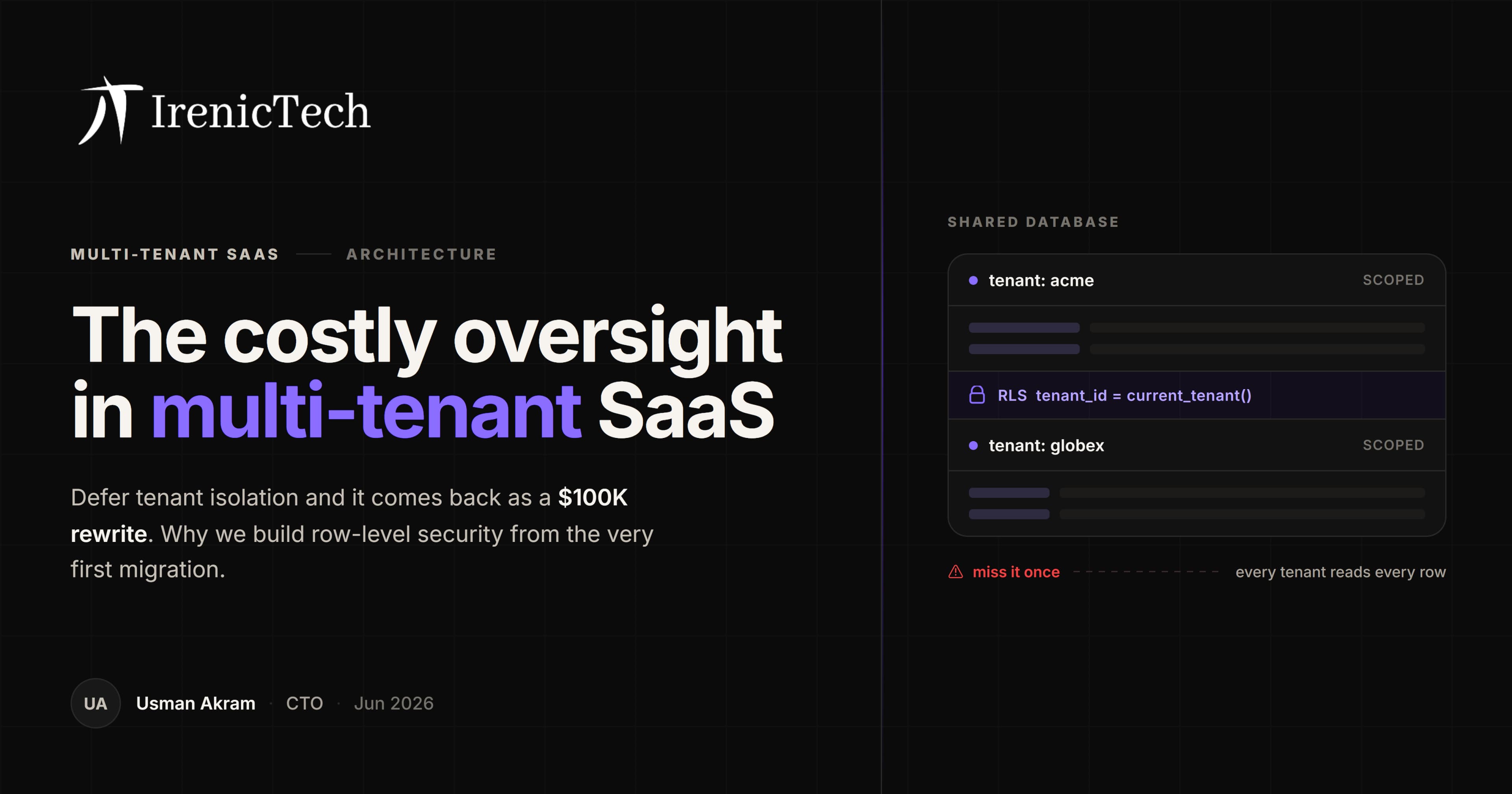
It's the same costly oversight we wrote about with multi-tenant SaaS. Isolation, evals, and compliance get filed under "after product-market fit," and then an enterprise forces the issue and you find out retrofitting them isn't a feature, it's a rewrite. Meanwhile the customer who triggered it is sitting there waiting while you tear things apart.
How we build one that ships and scales
Our habit is to put the boring foundations in before the features that lean on them. Row-level tenant isolation from the very first migration, so a single forgotten check can't quietly hand one customer another's data. Evals and guardrails around the model, so its decisions are measured instead of taken on faith. Observability and a correction loop, so the product actually gets better the more it's used rather than repeating the same wrong answer forever. That last part is the same discipline behind how we ship AI products in weeks.
Pulled together, that's our SaaS Platforms and AI Native practices working as one: a product that's genuinely AI-native underneath, and engineered to survive the review that always comes after the demo. The market's moving quickly. The companies that actually win it are the ones still standing when the first big customer gets to the fine print.
If you're building in this space, let's compare notes. We've shipped multi-tenant, AI-native platforms before, and we know where the bodies are buried.
Frequently asked
What is AI-native vertical SaaS?
AI-native vertical SaaS is software built around AI from the ground up to serve one specific industry, such as healthcare, legal, or logistics, rather than AI added as a feature to a general-purpose tool. The AI owns part of the workflow and makes decisions inside it, and the product is shaped around the rules, data, and outcomes of that single vertical.
How is AI-native different from adding AI features to SaaS?
AI-enhanced SaaS bolts a chatbot or a summarize button onto an existing app; the product still works the same way without it. AI-native SaaS falls apart without the AI, because the model is doing core work inside the workflow, often invisibly, without a human ever typing a prompt.
Why is vertical SaaS outperforming horizontal platforms in 2026?
Vertical products win because they own an entire industry workflow and the data that comes with it, which compounds into outcomes a horizontal tool can't match. In 2026, vertical SaaS is projected to drive about 60% of new market growth, and AI-native vertical companies are hitting $100M ARR faster than any previous SaaS generation.
How do you build an AI-native SaaS that's ready for enterprise?
Build the unglamorous foundations first: tenant isolation with row-level security from the first migration, evals and guardrails around the AI, observability, and compliance readiness. A great demo gets you the meeting; passing the enterprise security review gets you the contract.
CTO, IrenicTech
Usman is the CTO of IrenicTech. He builds AI agents, RAG systems, and automations into web and mobile products, and gets them shipped in weeks instead of quarters. He's focused on AI that learns from the people using it, and that's secure enough to trust with real data.
Connect on LinkedIn