Multi-Agent Systems: How Teams of AI Agents Are Starting to Run Software Work in 2026
One AI agent is useful. A coordinated team of them is a different kind of power, and a different kind of risk. Here's what multi-agent systems actually are, where they earn their keep, and what it takes to run them without creating chaos.
Usman Akram · · 4 min read
The story of agentic AI in 2026 has a clear next chapter, and it's already being written. For a while, the exciting thing was a single AI agent that could take a goal and work through it on its own. Useful, genuinely. But the frontier has moved, and the new question is what happens when you stop using one agent and start using a team of them.
What a multi-agent system actually is
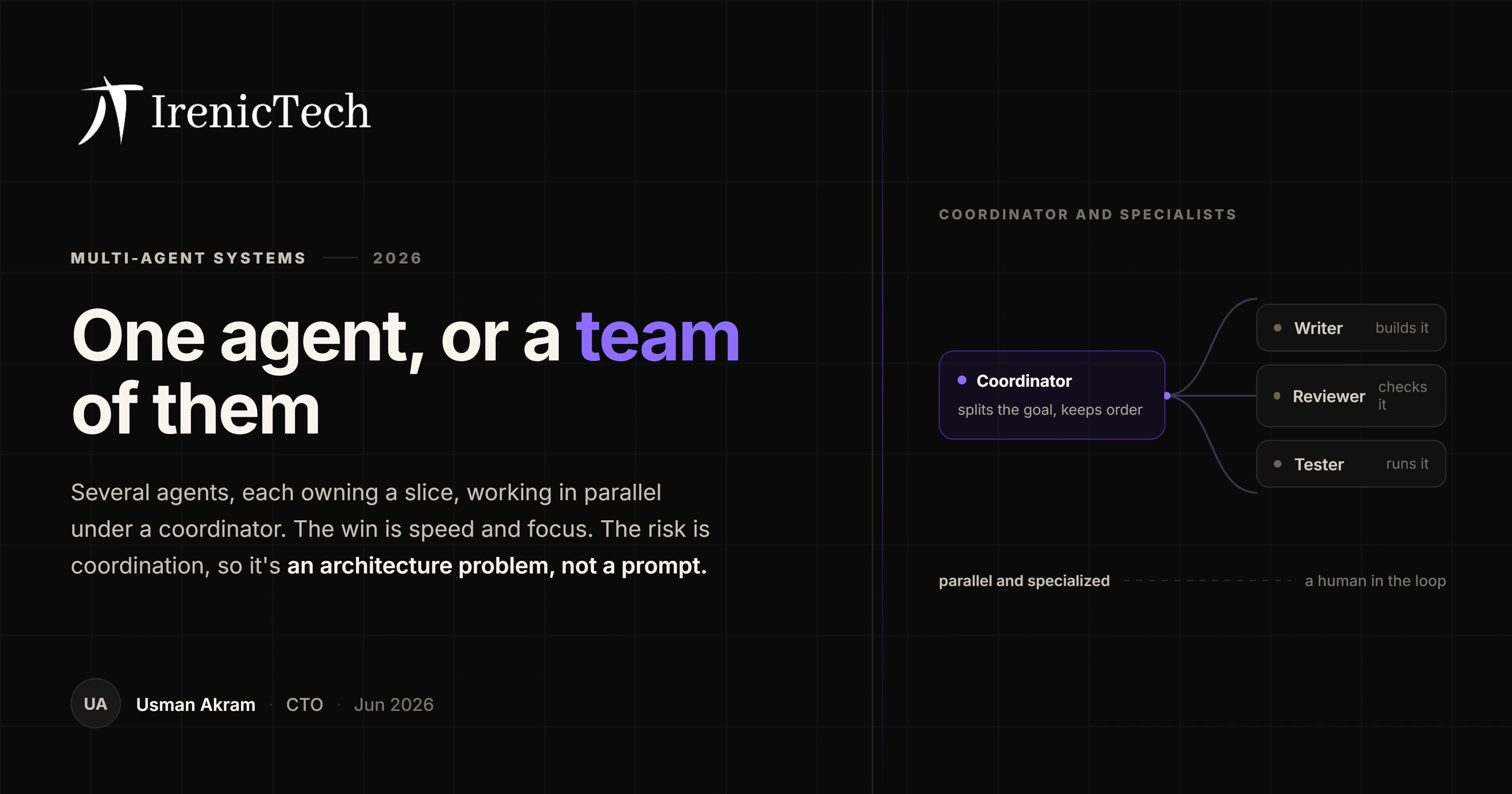
A multi-agent system is several AI agents working a larger job together, each responsible for a slice of it, with something coordinating the whole effort. Instead of one agent trying to do everything end to end, you have one writing code, another reviewing it, another running the tests, and a coordinating layer keeping them all pointed at the same goal.
If that sounds like a software team, that's the point. The mental model is a small crew with a lead, not a single brilliant freelancer. And like a real team, it can take on work that's too big for any one member, as long as somebody makes sure they're not tripping over each other.
Why bother with more than one agent
Two reasons, and they're both practical.
The first is parallelism. One agent works through a job step by step, in order. A team of agents can work on different parts at the same time. For a big task, that's the difference between an afternoon and a week, and the gap only widens as the job gets larger.
The second is specialization. An agent that's set up and focused for one specific job, reviewing code, say, tends to do that job better than a general agent trying to hold the entire task in its head at once. You can tune each agent for its role, give it just the tools and context it needs, and let it be good at one thing instead of mediocre at ten. The same instinct that makes you hire specialists onto a team applies here.
This isn't theoretical, either. There are already documented cases of agent systems running autonomously for several hours on a single hard task and delivering work at the end of it. The capability is real today, not on a roadmap.
Where it goes wrong
Now the honest part, because this is where the demos quietly fall apart. More agents means more ways to fail, and the failures are coordination failures, which are nastier than they sound.
Picture three agents working on the same codebase. Two of them edit the same file with different assumptions, and now the work conflicts. A decision gets made somewhere in the swarm and nobody can tell you which agent made it or why. Something ships and there's no trail explaining how it got there. None of those are the model being dumb. They're the system being badly organized, and you can't prompt your way out of a structural problem.
This is why multi-agent work is an architecture discipline, not a clever instruction you type once. How the agents coordinate, who owns which decision, how their work gets checked before it counts, how you can see what happened after the fact, all of that matters more than which model is under the hood. Get the architecture right and a team of mediocre agents outperforms one great one. Get it wrong and you've built an expensive way to generate chaos.
The human is still in the loop, and that's the design
It's tempting to picture a multi-agent system as a self-running machine you switch on and walk away from. That's not the 2026 reality, and pretending otherwise is how teams get burned. Even at the frontier, the picture is people orchestrating agents, not people replaced by them. The engineer's job moves up a level: from doing the work to directing the system that does the work, setting the goal, shaping how the agents collaborate, and reviewing what comes back. We dug into that shift in our piece on what agentic AI development actually is, and it's the foundation everything here sits on.
Designing for that supervision from the start is the whole game. The systems that work treat human review as a built-in stage, not an afterthought, and they make it easy to see and correct what the agents are doing. The ones that fail are the ones that bolted oversight on after something went sideways.
How to think about it for your business
You almost certainly don't need a multi-agent system yet, and that's the right place to start. Most real value still comes from one well-scoped agent doing one useful job. Multi-agent setups earn their complexity when a task is genuinely too big or too varied for a single agent, and when you can clearly define the roles and the coordination between them. Reach for the team when the job needs a team, not because it sounds advanced.
When you do get there, the build is mostly orchestration and guardrails, which is exactly the unglamorous engineering we like. If you're weighing whether a job needs one agent or several, and how to run them without creating a mess, that's the conversation we have with clients on our AI-native engineering service. Tell us what you're working on and book a discovery call, and we'll give you a straight answer for your case.
Frequently asked
What is a multi-agent system in AI?
A multi-agent system is a setup where several AI agents work together on a larger task instead of one agent doing everything. Each agent typically owns a specific role, such as writing code, reviewing it, or running tests, and a coordinating layer keeps them aligned toward the overall goal. It mirrors how a human team divides work, with the agents handling their pieces in parallel under human oversight.
Why use multiple AI agents instead of one?
Two reasons: parallelism and specialization. Several agents can work at the same time, which is faster than one agent doing everything in sequence, and each agent can be focused and configured for the specific job it's best at, which tends to produce better results than one general agent juggling everything. The trade is added complexity, because now the agents have to coordinate.
Are multi-agent systems reliable enough to use in 2026?
For well-scoped tasks with human oversight, increasingly yes, and there are documented cases of agent systems running autonomously for several hours on a single complex job. But reliability comes from the architecture around the agents, not the agents alone. Without clear roles, coordination, and review, multiple agents create more ways to fail, not fewer. The teams getting value design the orchestration carefully and keep a human in the loop.
What's the difference between an AI agent and a multi-agent system?
A single agent takes one goal and works through it on its own. A multi-agent system breaks a larger goal into parts, hands each part to an agent suited to it, and coordinates the results. Think of the difference between one capable generalist and a small team with a coordinator. The team can take on bigger work, but it only beats the generalist if the coordination is good.
CTO, IrenicTech
Usman is the CTO of IrenicTech. He builds AI agents, RAG systems, and automations into web and mobile products, and gets them shipped in weeks instead of quarters. He's focused on AI that learns from the people using it, and that's secure enough to trust with real data.
Connect on LinkedIn