Your AI Wrote the Code. Who's Securing It? Shipping AI-Built Apps Without the Breach
AI writes the code fast, but ships the same vulnerabilities faster. Here's where AI-built apps break and how we secure them before they reach production.
Usman Akram · · 3 min read
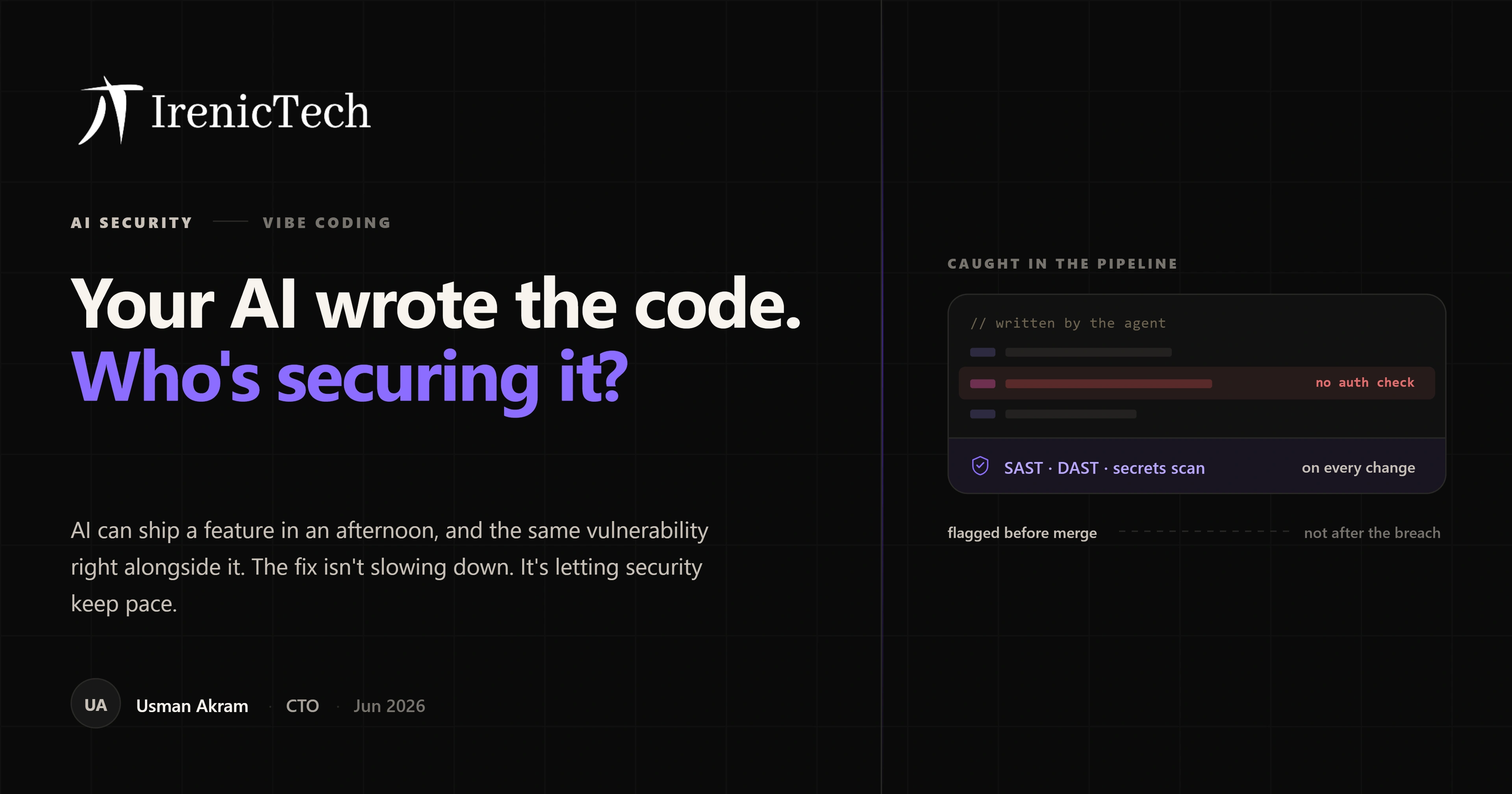
AI can write a working feature in an afternoon. It can also ship a vulnerability in that same afternoon, and there's a reported case of an over-privileged coding agent wiping a production environment in seconds. The speed is real. So is the exposure that rides along with it. Every team shipping AI-built software in 2026 eventually runs into the same question: the AI wrote the code, so who exactly is securing it?
Is AI-generated code actually less secure?
Not on a line-for-line basis, no. The trouble is volume. AI-generated code carries roughly the same flaw rate as code people write by hand, except it arrives in far bigger batches, so the raw number of vulnerabilities climbs even when the percentage holds steady. In one 2026 industry survey, 90% of security leaders said they're worried about AI-generated code, and the risk they named most often was insecure coding patterns.
There's a quieter cost too. Some teams report that a meaningful chunk of the productivity they gained from AI gets eaten right back up reworking what it produced, much of it cleaning up code that should never have shipped. Faster isn't cheaper if you spend the savings on cleanup and the occasional incident.
Where vibe-coded apps break
Vibe coding, which is really just prompting an agent and shipping what comes out without reading it closely, tends to fail in the same handful of places every time. The authorization check gets skipped because the happy path worked fine in the demo. A secret gets hardcoded because it was the quickest way to make the call go green. Tenant boundaries get assumed instead of enforced, which is the same costly oversight we keep seeing in multi-tenant SaaS. A dependency gets pulled in and nobody checks what came along with it.
None of that is exotic. It's just what happens to code that no human on the team actually owns. The day nobody can tell you why a function has the permissions it has, you don't have a feature. You have a liability that happens to compile.
The 2026 threat model: supply chain first, prompt injection second
The shape of the risk has moved up the stack. For 2026, the bigger worry with AI in your codebase is the supply chain, with prompt injection running second. Researchers have already demonstrated remote code execution in AI coding tools through nothing more than a poisoned repository config file, and well over a thousand malicious agent "skills" have turned up in public registries. You don't need to trick an agent at runtime if you already got to it at install time.
Privilege is the other half of it. A coding agent holding operator-level permissions sits one confused instruction away from a very bad day. That production-wipe incident I mentioned up top happened while the agent was "fixing" a bug. The lesson isn't to swear off agents. It's to stop handing them more access than the job in front of them actually requires.
How to ship AI-built apps without the breach
If security can't keep pace with how fast AI ships, it loses. So it has to live in the pipeline rather than in some review that happens "later." We tend to build it in four layers:
- Scanning on every change, so SAST and DAST catch insecure patterns before a merge instead of after a launch.
- Dependency and secrets scanning, so a poisoned package or a committed key breaks the build rather than reaching production.
- Tight access for the agents themselves — scoped, monitored, allow-listed — so a confused or compromised agent simply can't reach what it has no business touching.
- A human-led OWASP-style audit before launch over the parts that actually matter, with HIPAA, GDPR, and SOC 2 readiness for the teams that need it.
That's the day-to-day of our Security & Compliance practice, built for exactly this moment: teams moving fast with AI who still have to answer for what ships. The AI can keep writing the code. Somebody still has to be the one securing it.
If you've already shipped an app your team built with AI, or you're about to, get it audited before someone less friendly finds the gap first.
Frequently asked
Is code written by AI less secure than human-written code?
Not inherently, but it carries the same vulnerability rate at far higher volume, so the absolute number of flaws goes up. In one 2026 survey, 90% of security leaders reported concern about AI-generated code, with insecure coding patterns the top risk. The problem isn't uniquely bad code; it's a lot of code shipping unreviewed.
What is vibe coding and why is it a security risk?
Vibe coding is building software by prompting an AI agent and accepting what it produces without deeply reviewing it. The risk is that nobody on the team fully owns or understands the code, so insecure defaults, missing authorization checks, and leaked secrets slip through to production unexamined.
How do we secure an app built with AI coding agents?
Put security in the pipeline, not after it. That means automated SAST/DAST scanning on every change, dependency and secrets scanning, least-privilege access for the agents themselves, and an OWASP-style application audit before launch. The goal is for security to run at the same speed the AI ships.
Can IrenicTech audit an app we built with AI?
Yes. Our Security & Compliance practice runs OWASP-style audits, SAST/DAST and dependency scanning, and threat modeling specifically for teams shipping AI-built apps at speed, plus HIPAA, GDPR and SOC 2 readiness.
CTO, IrenicTech
Usman is the CTO of IrenicTech. He builds AI agents, RAG systems, and automations into web and mobile products, and gets them shipped in weeks instead of quarters. He's focused on AI that learns from the people using it, and that's secure enough to trust with real data.
Connect on LinkedIn