Why Austin's Record Startup Boom Is an AI Software Opportunity
Austin startups pulled in a record amount of venture funding in 2025, and most of it followed AI. Here's what that wave actually means for the companies riding it, and why funded ambition runs straight into a software-building problem.
Usman Akram · · 3 min read
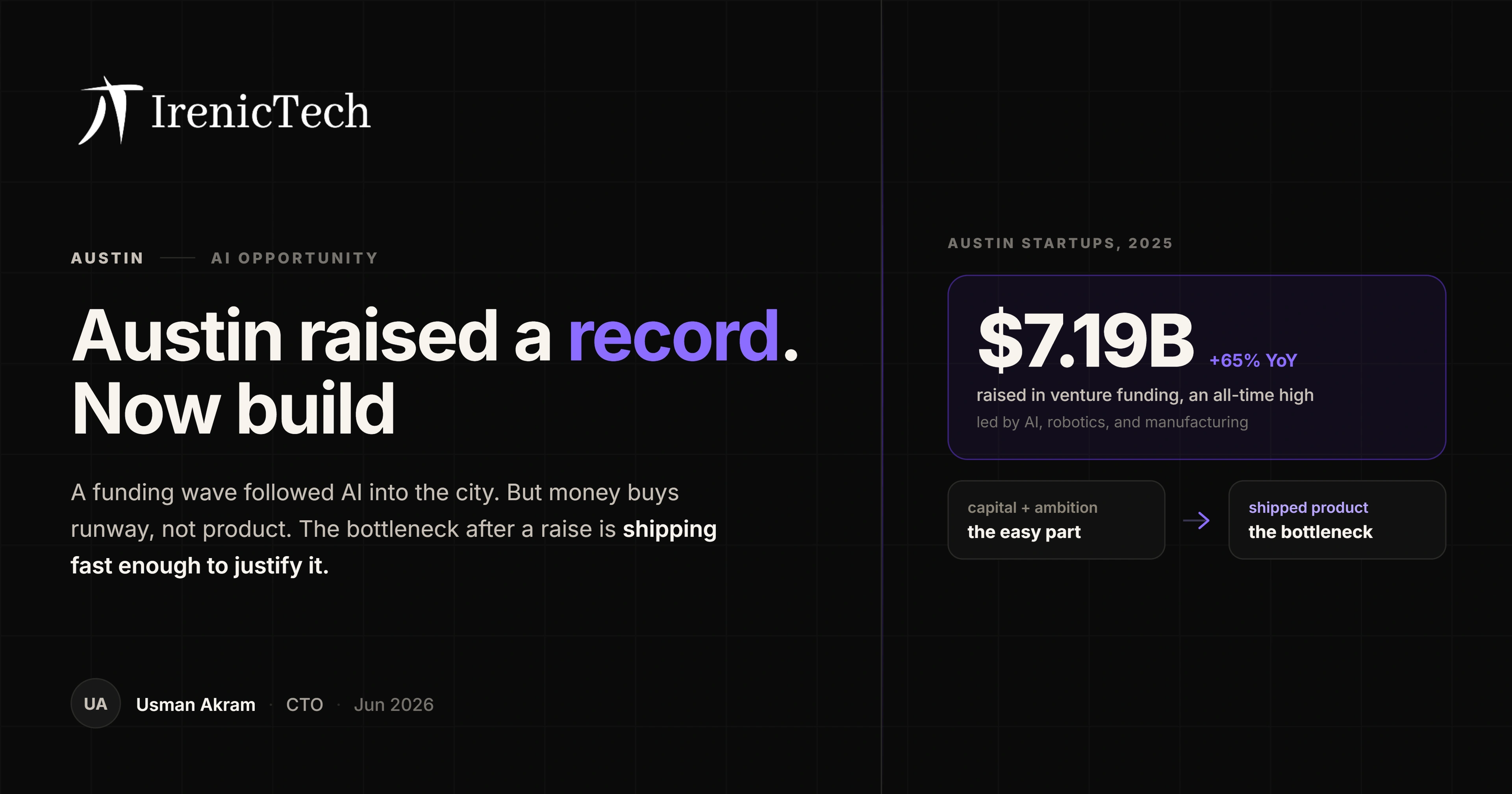
Numbers in venture capital are easy to glaze over, so here's one worth stopping on. In 2025, Austin startups raised a record $7.19 billion, up almost 65% on the prior year. That isn't a gentle uptick. That's a city's startup scene shifting into a higher gear, and the direction it shifted in tells you almost everything about where the next few years are headed.
Where the money actually went
The headline number is big, but the composition is the real story. The surge was led by AI, robotics, and advanced manufacturing. Capital is not spreading evenly across every kind of company. It's concentrating, hard, in businesses building intelligent systems and the machines that run them.
That concentration is a signal you can act on. When this much money moves in one direction in one year, it's the market making a bet out loud about what the next decade values. For Austin, the bet is plainly on AI-driven companies, and the funding wave is both a vote of confidence and a starting gun.
Why Austin, and why this matters beyond the headlines
Austin has been quietly assembling the ingredients of a serious tech hub for years: a deep and growing pool of engineering talent, real venture capital with offices in town rather than just visiting from the coasts, a business climate that makes setting up easy, and a cluster of companies in AI and hardware that pull more of the same toward them.
The thing that makes an ecosystem compound is density. When talent, capital, and customers sit close together, ideas move faster and companies find what they need without crossing the country to get it. The record 2025 funding is what that density looks like when it hits a moment the whole economy is leaning into. Austin happened to have built the runway right as the AI plane showed up.
The part the funding announcements skip
Here's where the celebration quietly turns into a problem. A raise is not a product. It's runway and a much higher bar, and the day after the round closes, the question changes from "can we raise" to "can we ship something that earns this."
That's where a lot of well-funded ambition stalls. The money buys time and raises expectations at the same time, and the bottleneck moves to execution: turning a pitch deck and a plan into AI software that actually works, in front of real users, fast enough to matter. Hiring helps, but hiring is slow, and a team you're still assembling can't ship the thing the valuation is now counting on. The gap between funded and shipped is where momentum goes to die.
Turning capital into product
The companies that make the most of a moment like this share a habit: they convert energy into shipped product quickly, instead of into headcount and announcements. They pick one genuinely useful thing, build it properly, get it in front of users, and learn from what comes back, rather than spending the first year of runway designing the perfect platform nobody has touched yet.
For AI-native products specifically, speed matters more than usual, because the technology and the competition both move fast. A working product that's in real users' hands and improving beats a more ambitious one still in design, and it isn't close. We've written before about shipping AI products in weeks rather than quarters, and a funding boom is exactly the environment where that speed stops being a nicety and becomes the whole advantage.
Where we fit
We build from Austin, in the middle of the ecosystem this funding wave is feeding, so this isn't an outside read for us. The work we do is the part that comes after the raise: taking a funded company's plan and turning it into a real, working, AI-native product, fast and without cutting the corners that come back to bite. That's the heart of our AI-native engineering service, and it's deliberately built around speed with guardrails rather than long discovery cycles a startup on the clock can't afford.
Austin's $7.19 billion year is a clear statement about where things are going. The companies that turn that capital into shipped product, instead of stalling between the raise and the launch, are the ones who'll still be talking about it in a few years. If you're one of them and want a team that can move at the speed your runway demands, tell us what you're building and book a discovery call.
Frequently asked
How much did Austin startups raise in 2025?
Austin-based startups raised a record $7.19 billion in venture funding in 2025, an increase of roughly 65% over the prior year, according to Crunchbase data. The growth was driven heavily by AI, robotics, and advanced manufacturing companies, with several large rounds going to local firms in those sectors. It was an all-time high for the city.
Why is Austin becoming a tech and AI hub?
Austin combines a fast-growing base of engineering talent, an established venture capital presence, a business-friendly environment, and a concentration of companies in AI, robotics, and hardware. That mix means capital, talent, and customers sit close together, which is exactly the density that lets a tech ecosystem compound. The record 2025 funding is both a result of that and a signal that it's accelerating.
What does the Austin funding boom mean for software companies?
It means rising demand and rising expectations. Funded startups need to ship real product quickly to justify their raises, and established companies in the region feel pressure to keep pace. For anyone building software, the opportunity is in helping these companies turn capital and ambition into working AI-native products fast, which is often where the actual bottleneck sits after a raise.
Does IrenicTech work with Austin-based companies?
Yes. We have an Austin presence and build AI-native web and mobile products for US companies, with a focus on getting real software shipped in weeks rather than quarters. That speed is usually what funded startups need most: not a long discovery cycle, but a team that can turn a plan into a working product quickly and safely.
CTO, IrenicTech
Usman is the CTO of IrenicTech. He builds AI agents, RAG systems, and automations into web and mobile products, and gets them shipped in weeks instead of quarters. He's focused on AI that learns from the people using it, and that's secure enough to trust with real data.
Connect on LinkedIn