Why Your Business Needs an AI-Enabled Website in 2026 (It's About Being Found by AI, Not Just Users)
An AI-enabled website in 2026 isn't a chatbot bolted to a brochure site. It's a site built to be understood by the AI engines that increasingly decide whether your business shows up at all. Here's what that means and why it matters now.
Usman Akram · · 4 min read
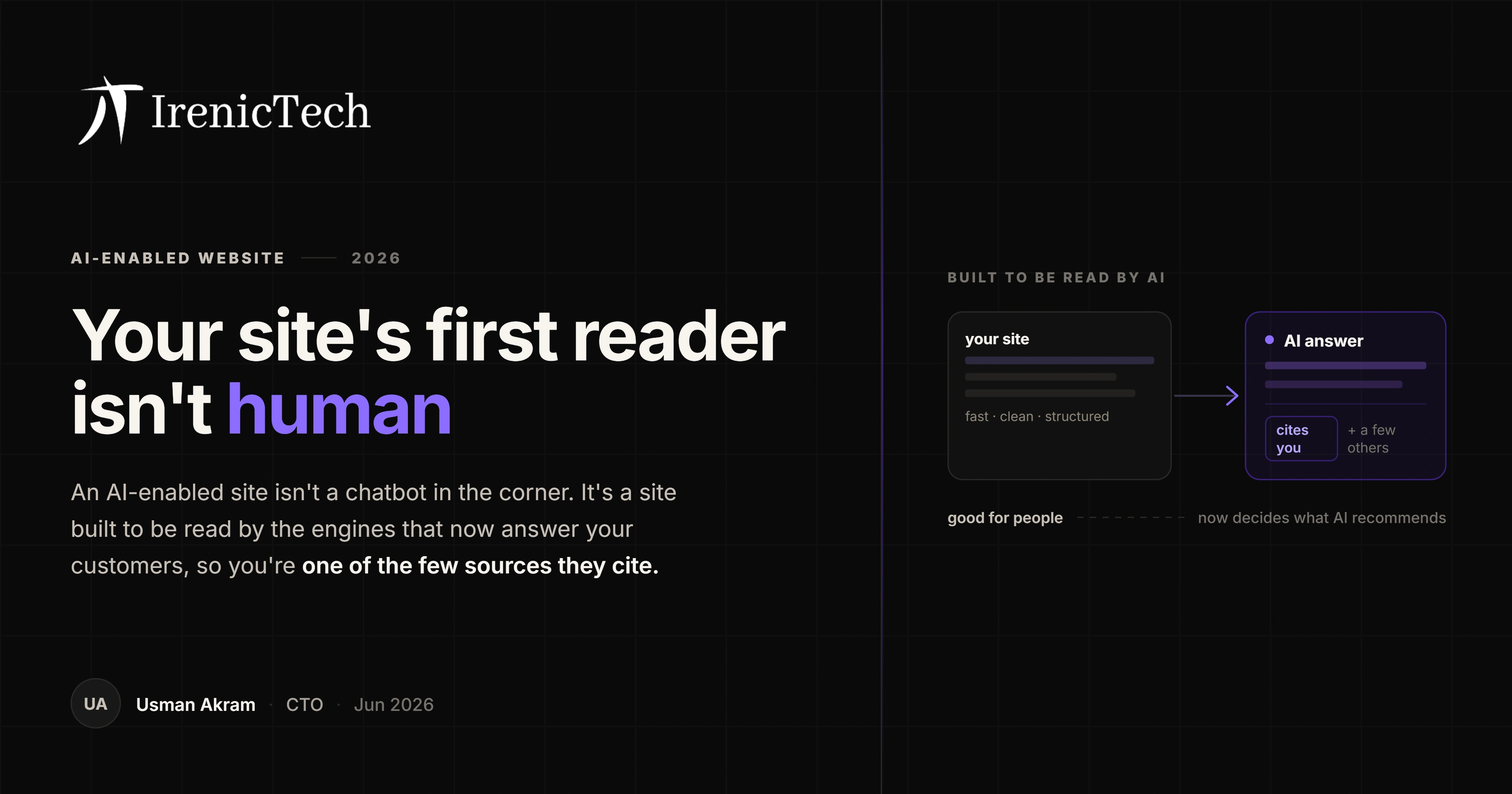
There's a quiet assumption baked into most business websites: that a person will arrive, read it, and decide. For years that was true, and it's becoming less true every month. A growing share of the time, the first thing to "read" your website isn't a person at all. It's an AI, deciding whether to mention you in the answer it's about to give your customer. If your site was built only with the human visitor in mind, it's now playing to an audience that left.
What "AI-enabled" actually means
Let's clear up the common misread first, because it sends people in the wrong direction. An AI-enabled website is not a brochure site with a chatbot wedged into the bottom corner. A chatbot is a feature. AI-enabled is a property of the whole site.
It means two things. The smaller, more obvious one is using AI inside the site: smarter search, personalization, support that actually helps. The bigger and far more overlooked one is being readable by AI from the outside, so that when an engine like ChatGPT or Perplexity or Google's AI answers a question your business could answer, your site is something it can understand, trust, and cite. In 2026, that second meaning is the one that moves the needle, and it's the one almost nobody is building for.
Why being found changed
For two decades, being found meant ranking on a search results page and earning the click. That's still real, but it's shrinking, because more and more questions never reach a page of links. Someone asks an assistant, and the assistant hands back a finished answer with a few small citations underneath. No list. No ten blue links to scroll. Just an answer, built from a handful of sources.
That changes the math completely. When a search returned a page of results, being sixth still got you noticed. When a search returns one answer citing three sources, sixth place doesn't exist. The window narrowed to a few slots per question, and whether you're in those slots depends on whether the AI could read and trust your site in the first place. A site the engine can't make sense of doesn't get a slot, no matter how good your business is.
The uncomfortable truth: a bad site is now invisible, not just ugly
Here's the part that should reframe how you think about your website. A slow, cluttered, thin site used to be a soft problem. It looked a bit dated, converted a bit worse, and you got to it eventually. Now it's a hard problem, because the same flaws that annoy human visitors actively stop AI from using your site.
AI engines favour sources that are fast to load, cleanly structured, and genuinely informative, because those are the sites they can parse and rely on. A page buried under bloat, broken structure, and marketing fluff with no real substance is exactly the page an AI skips in favour of a competitor who made theirs clear. So the cost of a weak site quietly changed. It used to cost you some conversions. Now it can cost you the entire question, because you never showed up to be considered.
The good news: this is mostly just good engineering
If that sounds like a daunting new discipline, here's the reassuring part. Being ready for AI is, overwhelmingly, the same work that makes a website good for people. There's no real trade-off to manage.
A fast site is better for visitors and easier for AI to crawl. Clean structure and sensible markup help a person scan and help a machine parse. Content that clearly and directly answers real questions serves the human reading it and the model trying to learn from it. Accurate, current information builds trust with both. The list of things that make a site AI-ready is almost identical to the list of things that make a site genuinely good, which means the effort serves both audiences at once. We get into the specifics of earning those citations in our piece on getting cited by AI engines, but the foundation underneath all of it is a well-built site.
That's also why this isn't something you bolt on. You can't sprinkle AI-readiness onto a site that's slow and structurally messy any more than you can fix a cracked foundation with a coat of paint. It comes from how the site is built, which is why the technology you build on actually matters, and why the Next.js versus WordPress question is really a question about how much control you have over exactly these fundamentals.
What to do about it
You don't need to panic or rebuild on a whim. You need an honest look at whether your site is fast, cleanly built, well structured, and genuinely useful, because those four things now decide whether AI will surface you, on top of whether people enjoy using you. If the answer is shaky, that's no longer a cosmetic issue you can keep deferring. It's the thing standing between your business and a growing share of the questions your customers are already asking.
This is the work we do: building sites that are fast, structured, and genuinely useful, so they serve the people who visit and the AI that increasingly decides who gets visited. It's the core of our web development service. If you want a straight read on where your site stands and what it would take to be ready for how people actually find businesses now, tell us what you're working on and book a discovery call.
Frequently asked
What is an AI-enabled website?
An AI-enabled website is one designed to work well in a world where AI mediates how people find and use information. That has two sides: being readable by AI engines so your business gets surfaced and cited in their answers, and optionally using AI inside the site itself, for things like smart search, personalization, or support. The more important and more overlooked half in 2026 is the first one, being understood by the AI that increasingly stands between you and your customers.
Why does my business website need to be AI-friendly in 2026?
Because a growing share of your customers now ask AI assistants the questions they used to type into a search engine, and those assistants build answers from a small set of sources they can read and trust. If your site is slow, messy, or thin, AI struggles to use it, and you don't get surfaced. An AI-friendly site is structured, fast, and genuinely informative, which is exactly what makes it eligible to be the source an AI answer is built from.
Is an AI-enabled website just a website with a chatbot?
No, and that's the common misunderstanding. A chatbot is a feature you add; an AI-enabled website is a site engineered to be understood by machines and useful to people at the same time. A chatbot on a slow, poorly structured site doesn't make it AI-enabled. The foundation, clean code, fast performance, clear structure, and strong content, matters far more than any single AI widget.
How do I make my website ready for AI search?
Start with the fundamentals: a fast, well-built site with clean structure and markup, content that directly and clearly answers the real questions your customers ask, and accurate, current information. Add structured data where it helps machines understand your pages. These are the same things that make a site good for human visitors, which is why doing them well serves both audiences at once rather than forcing a trade-off.
CTO, IrenicTech
Usman is the CTO of IrenicTech. He builds AI agents, RAG systems, and automations into web and mobile products, and gets them shipped in weeks instead of quarters. He's focused on AI that learns from the people using it, and that's secure enough to trust with real data.
Connect on LinkedIn