From SEO to GEO: How to Measure Whether AI Is Actually Recommending Your Business
Traditional SEO has clear metrics. AI visibility doesn't, yet, which is why most businesses have no idea whether AI engines recommend them. Here's how to actually measure it, what to track, and why it's harder and more honest than a ranking report.
Usman Akram · · 4 min read
There's an old management line about not being able to manage what you don't measure. It's a cliché because it's true, and right now it describes almost every business's relationship with AI search. Companies have spent a year being told to optimize for ChatGPT and Perplexity and AI Overviews, and almost none of them can tell you whether it's working, because they have no way to see whether those engines actually recommend them. They're optimizing blind.
This is the unglamorous half of the GEO conversation, and it's the half that separates people doing real work from people repeating buzzwords. So let's talk about how you actually measure it.
Why your old metrics went quiet
For twenty years, measuring visibility was tidy. You picked a keyword, you checked your rank, and the number told you roughly where you stood. It was stable, it was the same for everyone, and a hundred tools would report it for you. That whole apparatus is built for a world of ranked links.
AI answers don't work that way, and the old number quietly stopped meaning much. When a customer asks an assistant a question and gets a synthesized answer citing three sources, your keyword rank tells you nothing about whether you were one of them. You could rank perfectly well in traditional search and be completely absent from the AI answer to the same question, and your ranking report would never show it. The metric didn't get worse. It just stopped measuring the thing that increasingly matters.
What "measuring AI visibility" actually involves
Here's the shift in mindset. You're no longer reading a position on a list. You're asking a question and seeing whether you show up in the answer. That sounds simple, and the catch is that you have to do it at scale and repeatedly, because any single answer is just one roll of the dice.
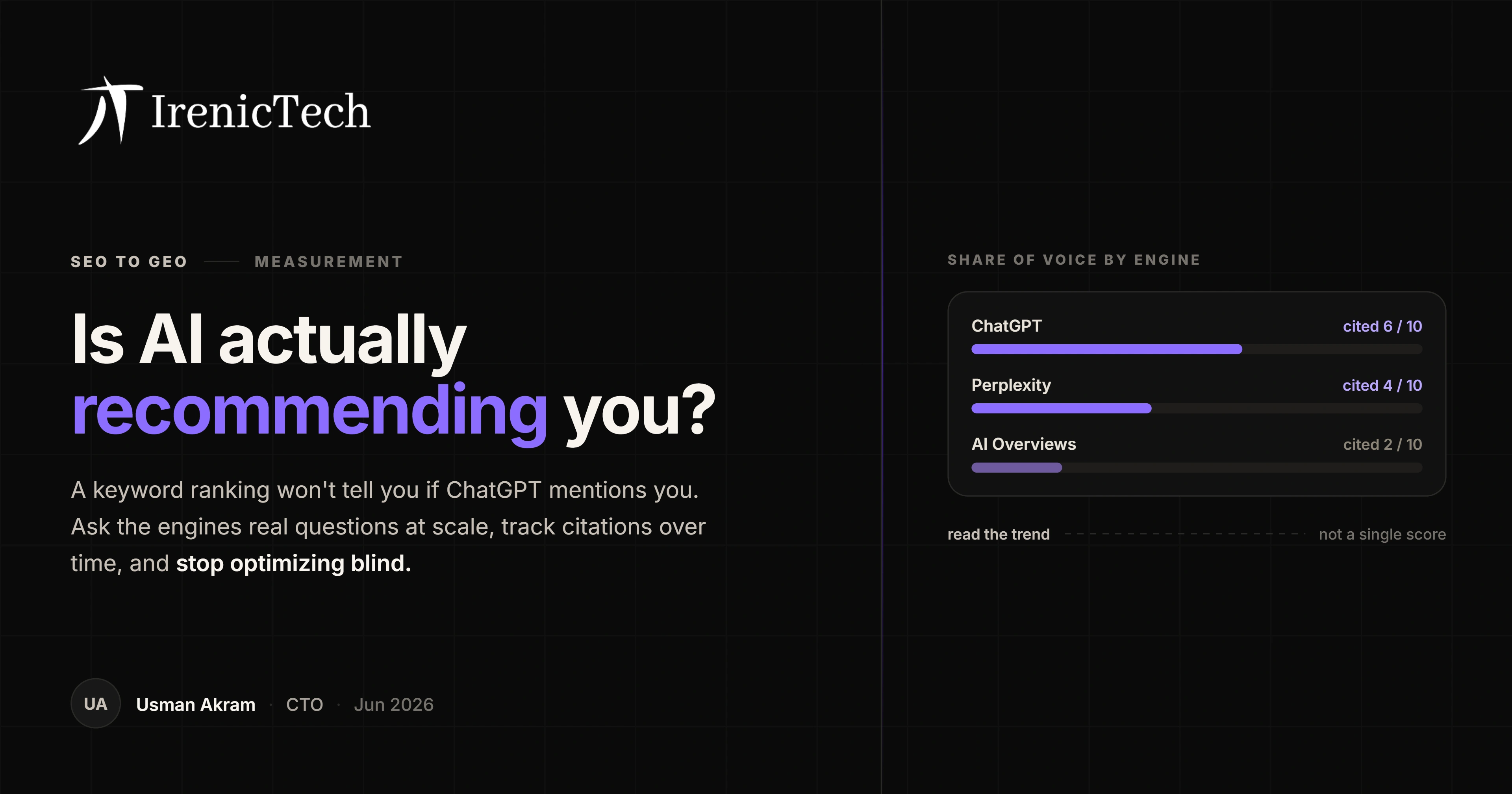
In practice it means taking the real questions your customers ask, the ones where being the answer turns into business, and putting them to the AI engines systematically. Then you look at what comes back. Were you mentioned? Were you cited as a source, or just described? How did you stack up against the competitors who showed up instead of or alongside you? You repeat that across many questions and across the different engines, because each one cites only a small handful of sources, often somewhere between two and seven, and they frequently disagree about who those sources should be. Being the answer in ChatGPT tells you little about whether you're the answer in Perplexity.
The metrics worth tracking
Once you're querying systematically, a few things are worth measuring, and they map cleanly to questions you actually care about.
- Citation frequency. Across the questions that matter to you, how often does the AI mention or cite you at all? This is the base rate, your raw presence.
- Share of voice. When you do or don't appear, who appears instead? Tracking yourself against named competitors turns a vague sense of "are we visible" into a real comparison.
- Prominence. There's a difference between being the primary source an answer is built on and being a footnote at the end. Where you land changes how much the visibility is worth.
- Accuracy. When the AI describes your business, does it get it right? Being cited inaccurately can be worse than not being cited, and it's something only this kind of checking will catch.
None of these is a single magic score, and that's the point. Together they tell you not just whether you're showing up, but whether showing up is doing you any good.
Treat it as research, not a dashboard
The biggest mistake is wanting this to behave like a rank tracker: one number, checked daily, going up and to the right. It won't, because AI answers are probabilistic. Ask the same question twice and you can get different sources. That variability isn't a flaw in your measurement, it's the nature of the thing you're measuring, and fighting it just produces anxiety.
So treat it as an ongoing research process instead. The value is in the trend over weeks and months, not any single reading. You measure, you publish better content or earn a credible mention, you measure again, and you watch whether your presence is climbing. Checking obsessively mostly generates noise. A steady cadence, monthly or whenever you've made a meaningful change, gives you signal you can act on.
And the acting is the whole point. Measurement on its own changes nothing; it just shows you the gaps. The questions where competitors get cited and you don't are a content brief. The answers that describe you wrong are a correction to make. The engines where you're invisible are a place to go earn mentions. Measuring AI visibility is worthwhile precisely because it tells you where to point the work we laid out in our playbook on getting cited by AI engines.
The honest bottom line
This is harder, fuzzier, and more manual than the SEO dashboards everyone got comfortable with, and anyone selling you a tidy single-number "AI visibility score" is overselling. But the businesses that measure it, even imperfectly, have an enormous edge over the ones optimizing on faith, because they can see which moves work and which don't. In a channel this new, just being able to see clearly is most of the advantage.
This is the kind of rigor we build into how we approach AI-era visibility for clients, measuring honestly, then doing the engineering and content work that actually moves the numbers. It's part of how we think about web development in 2026. If you want a real read on whether AI is recommending your business today, and a plan to improve it, tell us what you're working on and book a discovery call.
Frequently asked
Can you measure visibility in AI search results?
Yes, though it's less precise than traditional SEO. You measure it by querying AI engines like ChatGPT, Perplexity, and Google's AI Overviews with the questions your customers actually ask, then tracking whether your business is mentioned or cited, how prominently, and how that compares to competitors. Because answers are generated and vary, you do this across many prompts and over time to see a reliable pattern rather than a single definitive number.
What metrics matter for generative engine optimization (GEO)?
The core ones are citation frequency (how often you're mentioned or cited across relevant questions), share of voice against competitors (how often you appear versus them), prominence (whether you're a primary source or a footnote), and accuracy (whether the AI describes you correctly). Sentiment and which specific pages get cited are useful too. Together these tell you not just whether you're visible but whether the visibility is helping you.
Why is measuring AI visibility harder than traditional SEO?
Because the output isn't a fixed list. A search ranking is relatively stable and the same for everyone, so it's easy to measure. An AI answer is generated fresh, can differ between users and over time, and cites only a small handful of sources, often two to seven, with different engines making different choices. That variability means you have to sample many queries and look at trends rather than reading a single rank, which is more work and inherently fuzzier.
How often should I check my AI search visibility?
Periodically rather than obsessively. Because the answers shift, a single check is just a snapshot, so the value comes from tracking the trend over weeks and months, after you publish content or earn mentions, to see whether your presence is improving. Checking constantly mostly produces noise. A regular cadence, monthly or around meaningful content changes, gives you signal without chasing every fluctuation.
CTO, IrenicTech
Usman is the CTO of IrenicTech. He builds AI agents, RAG systems, and automations into web and mobile products, and gets them shipped in weeks instead of quarters. He's focused on AI that learns from the people using it, and that's secure enough to trust with real data.
Connect on LinkedIn