The Best Open-Source LLMs in 2026: GLM, DeepSeek, Qwen, Kimi, and MiniMax Compared
The open-weight LLM field flipped to Chinese labs in 2026, and the leaderboards are a mess of vendor-claimed numbers. This is an honest, use-case-first comparison of GLM, DeepSeek, Qwen, Kimi, and MiniMax, with the caveats that actually matter before you build on one.
Usman Akram · · 6 min read
Last verified June 2026. Open-weight rankings move fast, and the benchmark numbers below are mostly vendor-claimed, so treat this as a dated snapshot and confirm anything load-bearing against the source before you build on it.
If you looked at open-source language models a couple of years ago and looked again today, you'd barely recognize the leaderboard. The field flipped. The models people now reach for are largely from Chinese labs, the quality gap to the closed frontier narrowed a lot, and the whole thing moves so fast that any "best model" article is half stale by the time it's published, including this one. So rather than crown a winner, let me give you an honest map of the field and, just as important, teach you to read the numbers without getting fooled.
The short version
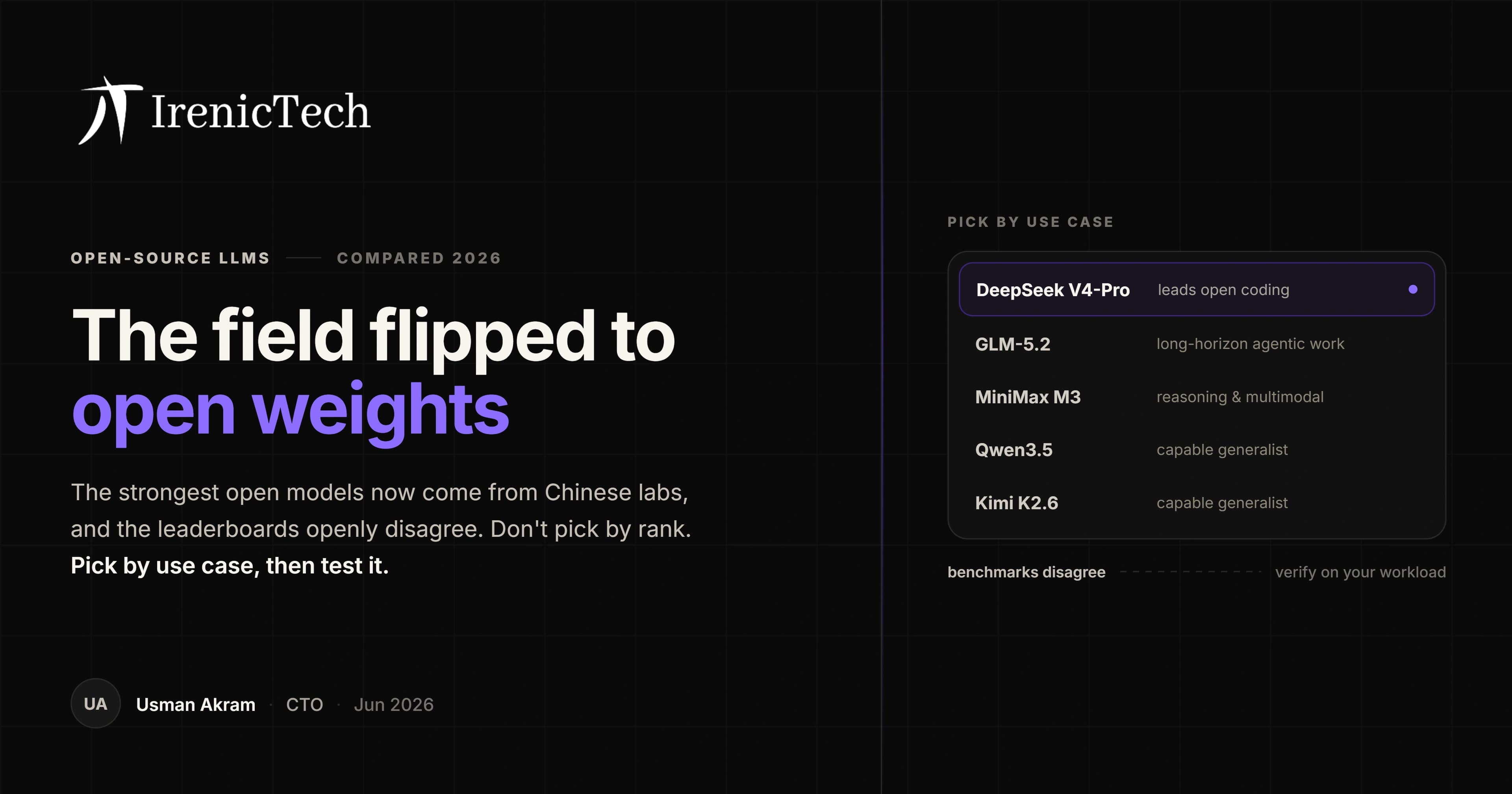
As of June 2026, the open-weight top tier is GLM from Z.ai, DeepSeek, Qwen from Alibaba, Kimi from Moonshot, and MiniMax, all Chinese labs, with OpenAI's gpt-oss as the main Western open option and Llama no longer in the conversation at the top. There's no single best. DeepSeek leads on published coding scores, GLM is strong on long-running agentic work, MiniMax leans reasoning and multimodal, and Qwen and Kimi are excellent all-rounders. Which one is right for you depends entirely on the job, the license, and whether you plan to run it yourself.
The models worth knowing
Here's the current field, with the facts that don't churn week to week. I've deliberately left raw benchmark scores out of this table, because they're contested and they age badly. More on that in the next section.
| Model | Lab | Latest (mid-2026) | Architecture (approx) | License | Leans toward |
|---|---|---|---|---|---|
| DeepSeek V4-Pro | DeepSeek | V4-Pro, April 2026 | ~1.6T MoE, ~49B active | Permissive (MIT-class) | Coding, strong all-round |
| GLM-5.2 | Z.ai (Zhipu) | 5.2, June 2026 | ~753B MoE, 1M context | MIT | Long-horizon agentic work, coding |
| Qwen3.5 | Alibaba | 3.5, February 2026 | ~397B MoE, ~17B active | Apache-class | Capable, efficient generalist |
| Kimi K2.6 | Moonshot | K2.6 (K2.7-Code newer) | ~1T MoE, long context | Modified MIT | Coding and agentic generalist |
| MiniMax M3 | MiniMax | M3, June 2026 | Sparse attention, 1M context | Verify before use | Reasoning, multimodal, long context |
| gpt-oss-120b | OpenAI | August 2025 | MoE, ~5B active | Apache 2.0 | Western open option, lighter |
Two things to flag right away. MiniMax M3's license has historically been more restrictive than the others, so confirm the exact terms before you treat it as freely deployable. And these "latest" versions turn over fast: GLM went 5.1 to 5.2 inside a couple of months, and Kimi shipped a coding-specific K2.7 shortly after K2.6. Check what's current when you read this.
How to actually read the benchmark numbers
This is the section most comparison articles skip, and it's the one that saves you from a bad decision. The open-model benchmarks flying around in 2026 are far less trustworthy than they look, for four specific reasons.
Most headline numbers are vendor-claimed. When a lab launches a model, the scores in the announcement were almost always produced by that lab, on its own infrastructure, against baselines it chose. That's not necessarily dishonest, but it isn't independent, and reproduction often lands weeks later with different figures. Treat a launch-day score as a claim, not a fact.
"Verified" and "Pro" are different tests. SWE-bench, the standard coding benchmark, comes in a Verified variant and a harder Pro variant. They are not comparable. Yet aggregators quote one model's Verified score next to another's Pro score in the same table all the time, which makes one look far better or worse than it is. If you see SWE-bench numbers, find out which variant before you compare them. As a rough feel, a model quoting ~80% is almost certainly on Verified, while ~60% is likely Pro.
"With tools" inflates the score. A model evaluated inside an agent harness, with tools and retries, scores much higher than the raw model answering once. Some of the most impressive numbers, especially on coding and on hard reasoning sets, are "with tools" figures quietly compared against other models' raw scores. Same trap, different benchmark.
Leaderboards disagree and go stale. Because releases land constantly, different leaderboards capture different moments. One ranks GLM-5.1 first because it hasn't ingested 5.2 yet; another ranks MiniMax M3 first on a page whose underlying data predates M3's launch. We genuinely found both while researching this. When the scoreboards contradict each other, the honest read is that the top is contested, not that one source is right.
The practical upshot: don't choose a model off a single number from a single leaderboard. Shortlist two or three, then run them on your own task with your own data. Your workload is the only benchmark that actually matters to you.
What leads, by use case
With all those caveats in hand, here's the directional picture as of June 2026.
For coding, DeepSeek V4-Pro holds the strongest published open numbers, with a vendor-claimed SWE-bench Verified result in the low 80s that, if it holds up independently, sits roughly level with top closed models. GLM-5.2 is the other serious coding pick, particularly for long, multi-step agentic tasks where it's been tuned to keep going.
For reasoning and multimodal, MiniMax M3 is the one to look at, with strong independent reasoning scores and native handling of more than just text, though watch its license. Kimi and Qwen are also strong reasoners and tend to be the most balanced generalists if you want one model that's good at most things.
For long context, several now advertise 1M-token windows (GLM, MiniMax, and others), which matters if you're feeding in large codebases or document sets. Verify the real-world quality at length rather than trusting the headline number, because usable context and advertised context aren't always the same thing.
For running light or staying on a Western-licensed model, gpt-oss-120b is the pragmatic choice. It trails the big Chinese MoEs on the hardest coding, but it's Apache-licensed, well understood, and lighter to run.
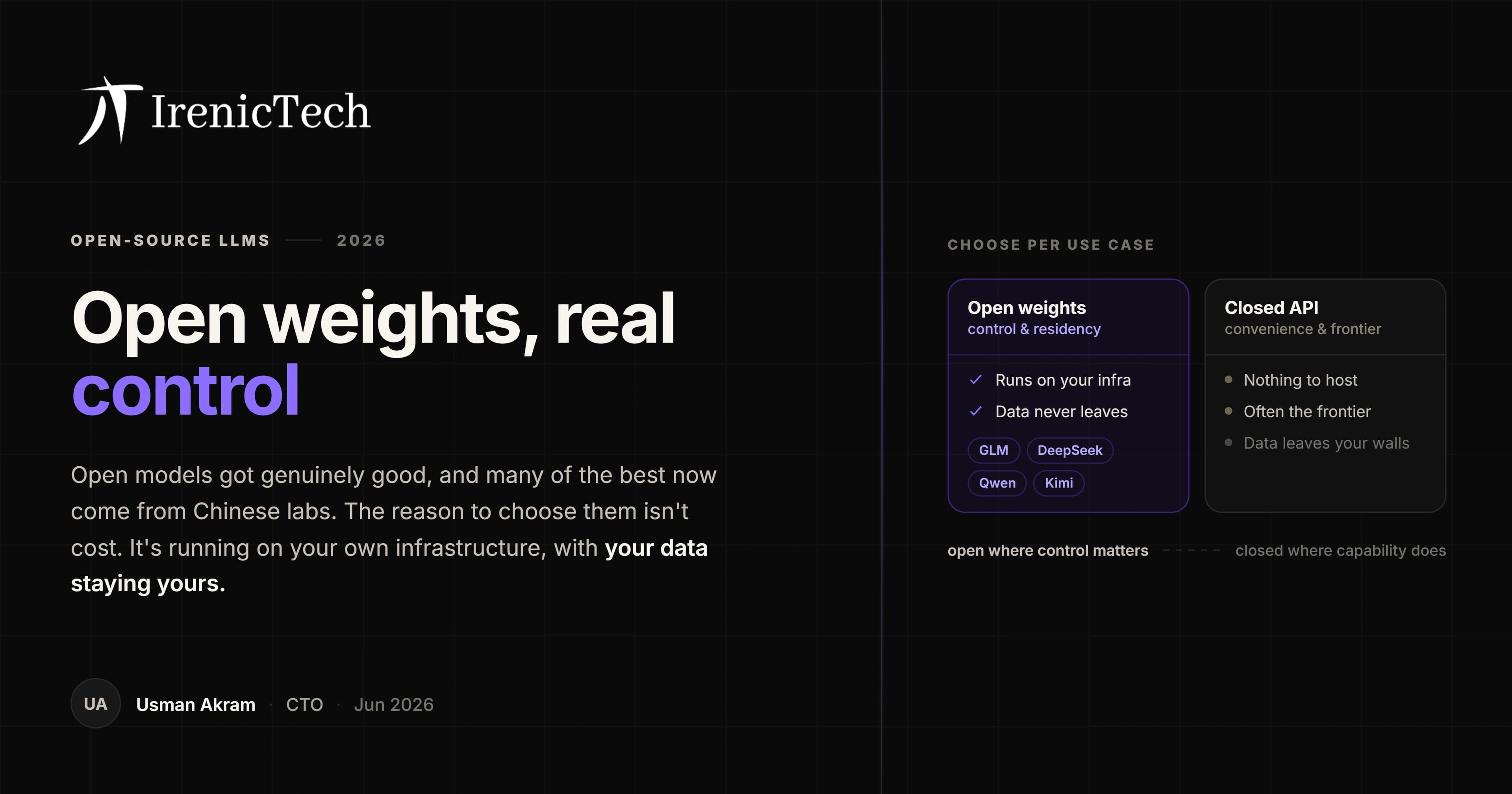
The thing that often decides it: license and control
For a lot of real products, the benchmark race isn't even the deciding factor. The license and where the model runs are. Several of these models ship under genuinely permissive licenses like MIT, which means you can self-host them, keep your data inside your own environment, and avoid sending anything to anyone, exactly what regulated industries and data-residency-conscious regions, much of the Gulf included, need. That control is frequently worth more than a few points on a benchmark, and it's the heart of the broader open versus closed decision for your product.
How we'd approach it
If we were picking an open model for a client build today, we wouldn't start from the leaderboard. We'd start from the job: what does it actually need to do, what are the license and data constraints, and where will it run. That narrows the field to two or three candidates fast. Then we'd test those candidates on the real task, because a vendor's SWE-bench score tells you very little about how a model handles your specific code, your domain, and your edge cases. The leaderboard is a starting point for a shortlist, never the decision.
If you're trying to choose an open model for a real product and want a recommendation grounded in your constraints rather than this month's contested rankings, that's the work we do on our AI-native engineering service. Tell us what you're building and where your data has to live, book a discovery call, and we'll give you a straight answer for your case.
Frequently asked
What is the best open-source LLM in 2026?
As of mid-2026 there is no single undisputed best, and anyone claiming one is oversimplifying. The top open-weight tier is held by Chinese labs: DeepSeek V4-Pro leads on published open coding benchmarks, GLM-5.2 (Z.ai) is strong on long-horizon agentic and coding tasks, MiniMax M3 leans toward reasoning and multimodality, and Qwen3.5 and Kimi K2.6 are both highly capable generalists. The right choice depends on your specific task, your license needs, and whether you'll self-host, so the honest answer is to shortlist two or three and test them on your own workload.
Are Chinese open-source models like DeepSeek and GLM safe to use?
The weights are files you can download and run in your own environment, and several ship under permissive licenses such as MIT, so when you self-host you are not sending data back to the lab that built the model. The reasonable diligence is the same as for any model: confirm the exact license terms, evaluate quality on your own task, and apply your normal data governance. Self-hosting specifically removes the data-sharing concern, because the model runs on infrastructure you control.
Why are the benchmark numbers for open LLMs so inconsistent?
Several reasons stack up. Most launch numbers are produced by the lab itself on its own setup, not independently reproduced. Different leaderboards test at different times, so a new release can make older rankings stale overnight. SWE-bench comes in a 'Verified' and a harder 'Pro' variant that are not comparable but get quoted in the same breath. And scores measured 'with tools' or inside an agent harness run higher than the raw model. So two sources can both be honest and still disagree wildly. Always check what exactly was measured.
Should I use an open-source LLM or a closed one for my product?
It depends on what you're optimizing for. Open-weight models give you control and data residency: you run them on your own infrastructure and your data never has to leave it, which matters in regulated industries and regions with strict data rules. Closed models often lead at the absolute frontier and are easier to run because someone else handles the infrastructure. Many products use both. We go deeper on that trade in our piece on choosing open-source LLMs for your product.
CTO, IrenicTech
Usman is the CTO of IrenicTech. He builds AI agents, RAG systems, and automations into web and mobile products, and gets them shipped in weeks instead of quarters. He's focused on AI that learns from the people using it, and that's secure enough to trust with real data.
Connect on LinkedIn