AI Agents Are Buying Things Now. Here Is What Your Store Has to Implement
Agentic commerce stopped being a demo. Three protocols now cover discovery, payment, and authorization, and as of June 2026 Shopify lets any developer register an agent without applying. The merchant-side work is concrete, and most stores have not started.
Usman Akram · · 6 min read
In September 2025, ChatGPT started letting people buy things. In November, Google shipped a checkout where it completes the purchase for you on the merchant's site. In January 2026, Google and Shopify launched a shared protocol for the whole flow.
And in June 2026, Shopify quietly removed the last gate: developers no longer apply for agent access. They register an agent profile and call a public endpoint.
The demo phase is over. What is left is an engineering question, and most stores have not started answering it.
Three protocols, and they are not competing
The common assumption is that this is a standards war and you should wait for a winner. That is a misreading. These protocols solve different layers and they are explicitly designed to stack.
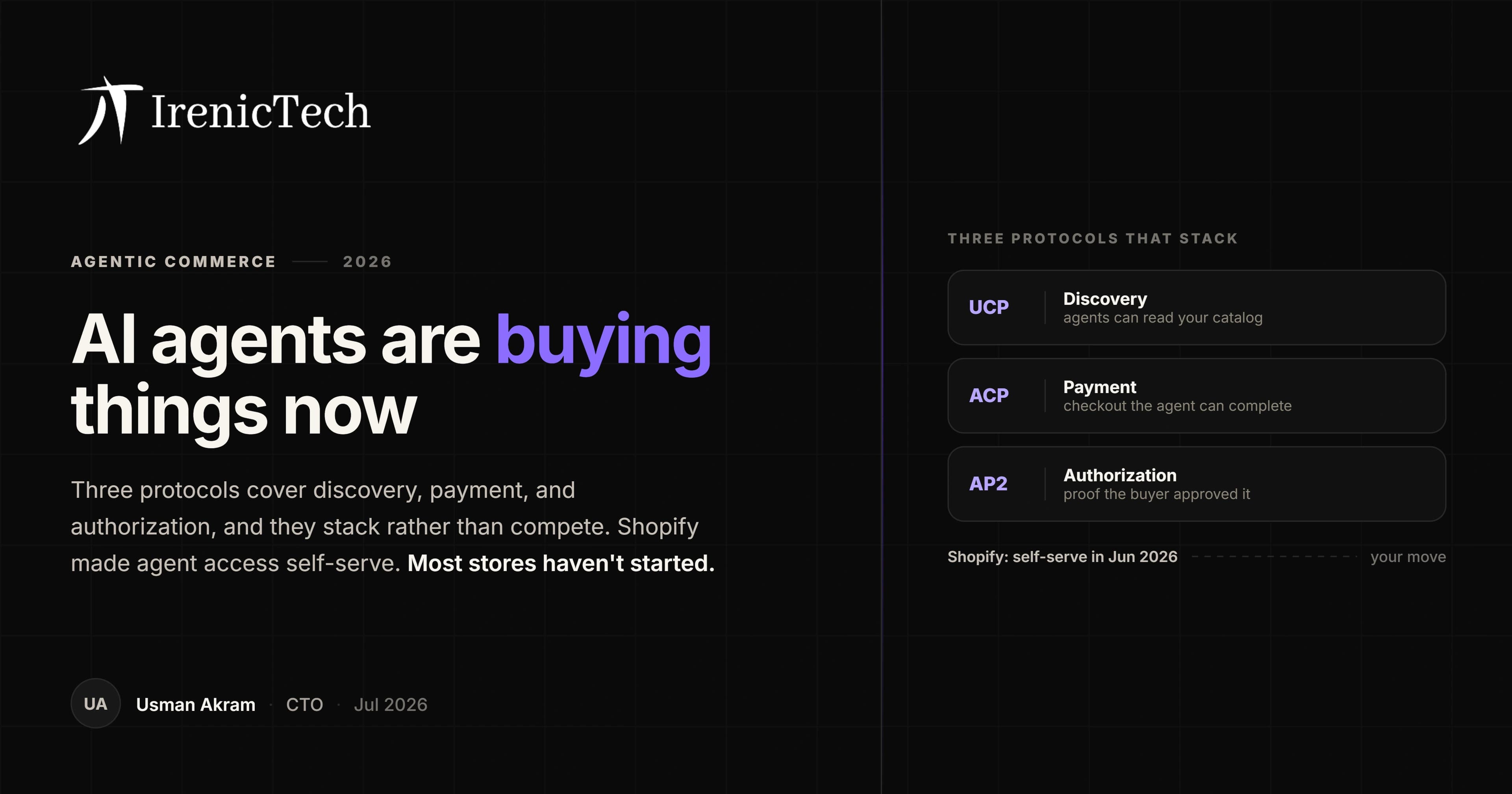
| Protocol | Who | What layer it solves |
|---|---|---|
| UCP (Universal Commerce Protocol) | Google and Shopify, January 2026 | Discovery, cart, checkout, post-purchase |
| ACP (Agentic Commerce Protocol) | OpenAI and Stripe, September 2025 | Executing the payment inside an AI surface |
| AP2 (Agent Payments Protocol) | Google, September 2025 | Authorization: proving who permitted the agent to spend |
Google states plainly that UCP is AP2-compatible. UCP's co-developer list has grown to include Amazon, Microsoft, Meta, Salesforce, and Stripe, alongside retailers like Etsy, Wayfair, Target, and Walmart. That is not the shape of a format war. That is the shape of an industry agreeing on plumbing.
The clean mental model: UCP is how the agent finds and buys. ACP is how the money moves. AP2 is how you prove the human said yes.
That third one deserves a moment, because it is the layer everyone underrates. When an agent spends money on someone's behalf, the question that eventually reaches a courtroom is who authorized it. AP2 exists to answer that with a cryptographic mandate chain rather than a support ticket. Mastercard extended this thinking in June 2026 with Agent Pay for Machines, which adds agent credentialing, programmatic spend limits, and settlement across cards, accounts, and stablecoins.
The Shopify change is the one that matters
On 17 June 2026, Shopify's Spring Edition made agent access self-serve. In their words, developers do not apply for UCP access, they register an agent profile in the developer dashboard and call the public MCP endpoint.
Read what that removes. There is no gatekeeper deciding which agents may transact against Shopify merchants. There is a registration form and an endpoint.
It shipped with a Catalog API described as UCP's discovery layer, whose purpose is turning products from millions of merchants into structured, queryable data across AI surfaces. There is a CLI. There is a plugin.
When a platform of that size removes the approval step and hands out the tooling, it is telling you the experimentation window is closed and the integration window is open.
The requirement is structured data, and it is unsexy
Here is the part that actually lands on an engineering backlog, and it is not the protocol.
An agent can only recommend and buy what it can query.
Your product page was written to persuade a human who is already looking at it. It has evocative copy, a hero image, and a size guide in a PDF. An agent needs attributes: dimensions, materials, compatibility, stock, variants, shipping constraints, return policy, all machine-readable, all complete, all correct.
Google shipped dozens of new Merchant Center attributes specifically for conversational commerce in January 2026. Shopify built a Catalog API whose entire purpose is turning merchant products into structured, queryable data. Both companies are telling you the same thing in product form: the catalog is the interface now.
This is the same lesson as the one in our GEO and AEO playbook, pushed from content into commerce. Being findable by an AI is a data problem. The difference is that in commerce, being findable is also being buyable, and the gap between the two is a checkout integration.
If your product data is a mess, no protocol will save you. An agent will simply recommend the competitor whose catalog it could parse.
What the numbers actually say
Be careful here, because this space is full of laundered statistics, and I found several while researching this piece.
What is solid:
Adoption of AI in shopping is broad. A Riskified survey of 5,400 consumers across nine markets found 73% already use AI somewhere in their shopping journey, while only 13% have completed a purchase after an AI referral. Worth knowing that Riskified sells fraud prevention to merchants, so read it as a vendor survey, but the shape is credible and the gap is the point. People are using AI to decide and then buying the old way. Every protocol above exists to close that gap.
On the enterprise side, McKinsey's State of AI found 62% of organisations at least experimenting with AI agents but only 23% scaling one anywhere in the business. Broad interest, narrow execution, which is exactly the moment where being early is cheap.
For the B2B picture, Gartner predicts that by 2028, 90% of B2B buying will be AI agent intermediated, pushing over $15 trillion of B2B spend through agent exchanges. Forrester, separately, expects about a third of B2B payment workflows to use autonomous agents by the end of 2026 and one in five B2B sellers to be pulled into agent-led quote negotiations.
And what I will not tell you: you may have seen a Morgan Stanley figure claiming half of online shoppers will use agents by 2030, accounting for a quarter of their spending. I could not source it. Morgan Stanley's actual published research says agentic shoppers could represent $190 billion to $385 billion in US e-commerce spending by 2030, capturing 10% to 20% of market share. Use that one. It is smaller, and it is real.
What to do, in order
- Fix the product data. Complete, structured, machine-readable attributes. This is a low-regret investment because it improves ordinary search and feed quality regardless of whether agents ever send you a customer. Do this even if you believe none of the rest.
- Find out what your platform already ships. If you are on Shopify, a large part of the protocol work is being done for you and the question is configuration, not construction. Do not build what your platform is about to hand you.
- Decide where you are willing to be bought. Agentic checkout inside someone else's surface means the sale happens without a visit to your site. That is a commercial decision about attribution, data, and customer relationship, not just a technical one. Make it deliberately.
- Do not pick a protocol winner. They stack. If you are implementing anything, implement the layer your channel requires and let the standards settle around you.
- Think about authorization early if you sell anything expensive. The question of who approved an agent's purchase becomes very interesting the first time an agent gets it wrong. That is what AP2 and agent credentialing exist for.
The summary
Agentic commerce has moved from announcements to protocols to self-serve tooling in about nine months. The plumbing now exists across discovery, payment, and authorization, the biggest commerce platform has opened the door by default, and the shoppers are already using AI to decide even though they are not yet using it to buy.
The merchant-side work is not exotic. It is the catalog. It always was.
If you sell online and want your products to be legible to the agents that are about to be doing the shopping, that is the intersection of our Web Development and AI Native practices. Tell us what you are running and book a discovery call.
Protocol details, launch dates, and all figures verified against primary sources on 12 July 2026: Google, Shopify, OpenAI, Stripe, Mastercard, Gartner, Forrester, McKinsey, Morgan Stanley, and Riskified.
Frequently asked
What is agentic commerce?
It is commerce where an AI agent performs some or all of the buying on a person's behalf, from finding the product through to completing the checkout, often without the shopper ever visiting the merchant's website. It has moved from concept to shipping product: OpenAI launched Instant Checkout in ChatGPT in September 2025, Google shipped agentic checkout in November 2025, and Perplexity partnered with PayPal to power agent purchases. The merchant-side consequence is that your storefront is no longer the only place a sale can happen.
What are UCP, ACP, and AP2?
They are three open protocols that solve different layers of the same problem. The Universal Commerce Protocol, launched by Google and Shopify in January 2026, covers discovery, cart, checkout, and post-purchase. The Agentic Commerce Protocol, from OpenAI and Stripe in September 2025, executes the payment inside an AI surface while the merchant remains merchant of record. The Agent Payments Protocol, from Google in September 2025, handles authorization, providing a cryptographic record of who permitted the agent to spend. They stack rather than compete, and Google states UCP is AP2-compatible.
What does a merchant actually have to build for AI agents?
Start with structured product data, because it is the prerequisite for everything else. An agent can only recommend and buy what it can query, which means your catalog needs clean, complete, machine-readable attributes rather than product descriptions written for human browsing. Google shipped dozens of new Merchant Center attributes for conversational commerce in January 2026, and Shopify's Catalog API exists specifically to turn merchant products into structured, queryable data across AI surfaces. After that, you implement the protocol layer appropriate to where you sell.
Is agentic commerce actually happening or is it hype?
Both, and the numbers are worth reading carefully. Adoption of AI in shopping is genuinely broad: a Riskified survey of 5,400 consumers found 73% use AI somewhere in their shopping journey. But conversion through agents is still rare, with only 13% having completed a purchase after an AI referral. Morgan Stanley projects agentic shoppers could account for $190 billion to $385 billion in US e-commerce by 2030, roughly 10% to 20% of the market. So it is real, it is early, and the infrastructure is being laid now.
Should a small store do anything about this yet?
Do the structured data work, because it pays off regardless. Clean, complete, machine-readable product data improves your ordinary search visibility, your feed quality, and your ability to be surfaced by AI assistants, and it is the prerequisite if agentic checkout matters to you later. That is a low-regret investment. The protocol integration itself can wait until you see agent traffic or your platform ships it for you, which increasingly it will.
CTO, IrenicTech
Usman is the CTO of IrenicTech. He builds AI agents, RAG systems, and automations into web and mobile products, and gets them shipped in weeks instead of quarters. He's focused on AI that learns from the people using it, and that's secure enough to trust with real data.
Connect on LinkedIn