Developers Use AI for 60% of Their Work and Can Delegate Almost None of It
Anthropic's own research says developers use AI across roughly 60% of their work but can fully delegate only 0% to 20% of tasks. That gap is not a failure of the models. It is the actual shape of agentic development, and it changes what you should expect from an AI-native team.
Usman Akram · · 4 min read
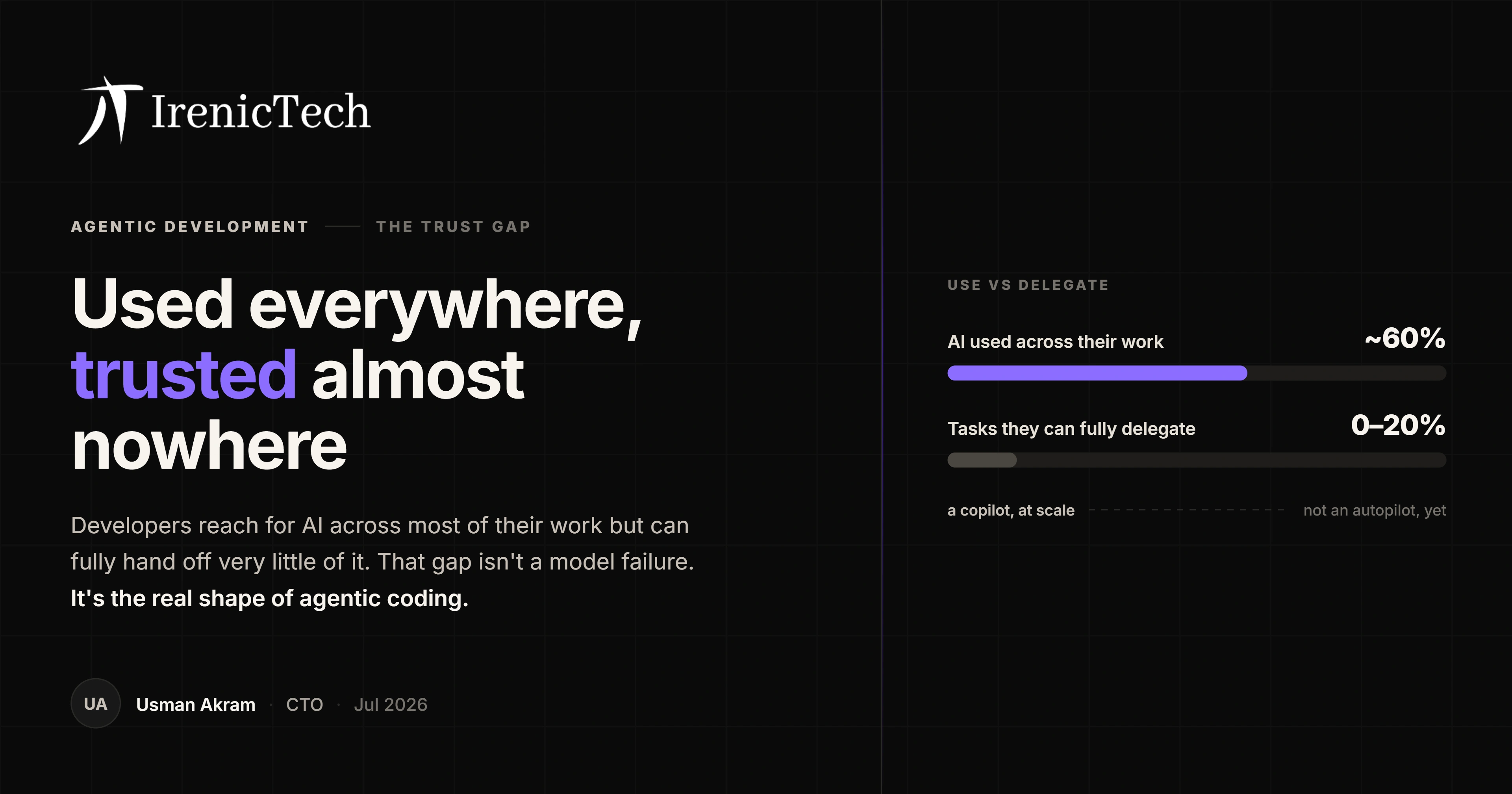
Two numbers from Anthropic's own research, sitting right next to each other:
Developers use AI in roughly 60% of their work.
Developers report being able to fully delegate 0% to 20% of tasks.
Most people read that and assume one of them must be wrong. Neither is. The gap between those two figures is the most honest description of agentic coding in 2026 that I have seen, and almost every strong opinion about AI and software development is really just an argument about which number to ignore.
The two camps are both reading half the data
The maximalists quote the 60% and conclude that engineering is basically solved, that headcount is a legacy concept, and that anyone still hiring developers has not understood what is happening.
The skeptics quote the delegation figure and conclude the whole thing is a party trick, that it writes plausible nonsense, and that the emperor is quite obviously naked.
They are describing the same tool. AI is in most of the work. It can be trusted to finish very little of it alone. Both facts, at the same time, without contradiction.
What that actually describes is a fast, tireless, occasionally overconfident collaborator that is genuinely useful across the majority of your work and cannot be left alone with the outcome. Anyone who has managed a talented junior will find this an extremely familiar shape.
The productivity argument nearly everyone makes is the wrong one
Here is the finding that reframed this for me. Anthropic's data suggests roughly 27% of AI-assisted engineering work is work that would not have been done at all without it.
Not done faster. Done at all.
The internal tool that would have saved the support team six hours a week and never cleared the backlog. The exploratory spike nobody could justify. The papercut bug that annoyed everyone for a year and was never worth a sprint slot. The refactor that was obviously correct and obviously not urgent.
That is a completely different economic claim than the one in every AI sales deck. The pitch is "your team ships the same work faster." A large chunk of the actual value is "your team ships work it was previously never going to ship."
It also explains why so many teams run an AI pilot, measure cycle time, see a rounding error, and conclude the tools do not work. They measured the wrong thing. The output grew sideways, into work that never appeared on the roadmap, and their metric could not see it.
Meanwhile, the horizon is genuinely stretching
It would be easy to read all this as deflationary. It should not be.
Anthropic reports that Rakuten pointed Claude Code at a vLLM implementation inside a codebase of 12.5 million lines. It finished in seven hours of autonomous work, in a single run, hitting 99.9% numerical accuracy against the reference method.
Seven hours. One run. A real codebase, not a toy repository with a tidy test suite.
The trajectory that implies is agents working across days, not minutes, with humans supervising at decision points instead of reviewing every line. That is a different working rhythm than autocomplete, and it arrives whether or not your team is ready for it.
Which means your bottleneck is about to move
Follow the logic. If generation gets cheap, fast, and long-horizon, while trust stays low, then the constraint in your engineering organisation stops being "can we write this" and becomes "can we verify this."
Most teams are not set up for that, because for the last twenty years the scarce resource was the writing.
An agent can hand you a 2,000 line change at four in the morning. It might be excellent. It might contain one subtly wrong assumption that no test covers, wrapped in code that reads beautifully, which is the most dangerous kind of wrong there is. Reviewing it properly takes real, expensive, senior attention. Not reviewing it properly takes about four seconds and feels great.
So the discipline that decides whether agentic development works for you is not prompting. It is the boring stuff:
- Test coverage that actually means something, because it is the only thing standing between a plausible change and production.
- Review capacity that scales with generation, or a deliberate decision to generate less.
- The willingness to reject work that looks right. This is a cultural muscle and most teams do not have it, because rejecting a colleague's work is socially expensive and rejecting a machine's work feels like admitting the machine beat you.
- Small, reviewable changes, because a large agent-authored diff is where the wrong assumption goes to hide.
We wrote about the adjacent version of this problem in shipping AI-built apps without the breach. Same root cause: the code arrives faster than the scrutiny.
What we actually tell clients
That AI-native does not mean "the AI does it." It means the team is built around the reality of these two numbers.
Use it everywhere. Trust it nowhere unsupervised. Invest the time you save on generation into verification, because that is where the risk migrated. Expect the win to show up as more things shipped rather than a dramatic drop in cycle time, and measure accordingly, or you will conclude your working tools are broken.
The teams getting real leverage out of this are not the ones with the cleverest prompts. They are the ones who took the delegation number seriously and built the review discipline to match the generation speed.
If you want an engineering partner that works this way rather than one selling you the 60% and quietly hoping you never check the other number, that is how our AI Native practice runs. Tell us what you are building and book a discovery call.
Figures from Anthropic's 2026 Agentic Coding Trends Report. Verified against the primary source on 12 July 2026.
Frequently asked
How much of a developer's work is actually done by AI?
Anthropic's Societal Impacts research found developers use AI across roughly 60% of their work, but report being able to fully delegate only 0% to 20% of tasks. Those two numbers are not in conflict. AI is involved in most of the work while being trusted to finish very little of it unsupervised. The realistic model is a fast, capable collaborator that still needs a human deciding what is right, not an autonomous replacement.
Does AI actually make developers faster?
Sometimes, but speed may be the wrong thing to measure. Anthropic's data suggests about 27% of AI-assisted engineering work consists of tasks that would not have been done at all otherwise: exploratory work, internal tools nobody had time to build, small papercut fixes that never cleared the priority bar. That means a meaningful share of the value shows up as increased output volume rather than the same output delivered faster. If you measure only cycle time, you will miss most of the gain and possibly conclude the tools are not working.
Can AI agents work autonomously for long periods now?
The horizon is expanding quickly. Anthropic reports that Rakuten tested Claude Code on a vLLM implementation inside a 12.5 million line codebase and it completed the job in seven hours of autonomous work in a single run, achieving 99.9% numerical accuracy against the reference method. That is a genuine multi-hour autonomous task on a real codebase, not a demo. The direction of travel is toward agents that work for days with human oversight at decision points rather than line by line.
What is the real bottleneck in AI-assisted development?
Review. When generating code becomes cheap and fast, the constraint moves to verifying that the code is correct, safe, and actually solves the problem. Teams that scale up generation without scaling up review capacity end up with a larger queue of plausible-looking changes that nobody has genuinely checked. The engineering discipline that matters most in an agentic workflow is not prompting. It is testing, code review, and the ability to say no to something that looks right.
CTO, IrenicTech
Usman is the CTO of IrenicTech. He builds AI agents, RAG systems, and automations into web and mobile products, and gets them shipped in weeks instead of quarters. He's focused on AI that learns from the people using it, and that's secure enough to trust with real data.
Connect on LinkedIn