98% of FinOps Teams Now Manage AI Spend. Two Years Ago It Was 31%
The State of FinOps 2026 says 98% of practitioners now manage AI spend, up from 31% two years ago. It also says the easy cloud savings are gone and teams are being asked to self-fund AI out of optimization. Those two facts collide.
Usman Akram · · 5 min read
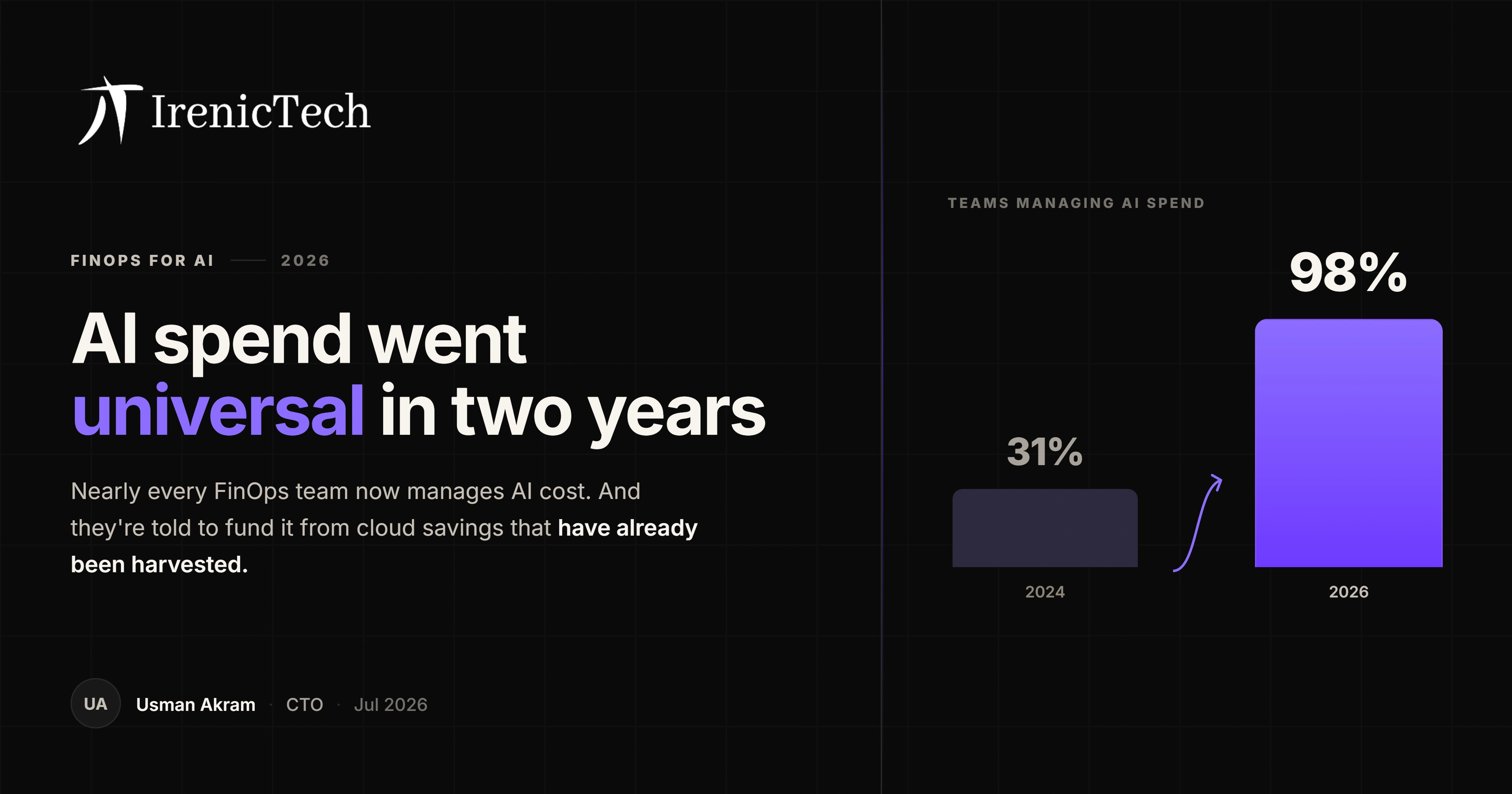
Two years ago, 31% of FinOps practitioners managed AI spend. In the 2026 State of FinOps survey, it is 98%.
That is not growth. That is a category arriving all at once. And the same report contains the fact that makes it awkward: the easy cloud savings are already gone.
The number in context
The FinOps Foundation's 2026 report is its sixth annual survey, drawing on 1,192 respondents who between them represent more than $83 billion in annual cloud spend. So this is not a vendor poll of a hundred people.
Inside that population, managing AI spend went from a minority activity to a near-universal one in twenty four months. And AI cost management is now the number one skillset teams say they need to develop, which is a polite way of saying almost nobody currently has it. The discipline is being invented in real time by the people practising it, which is exactly the phase where bad habits calcify.
Why AI spend breaks the FinOps playbook
The classic cloud cost problem is waste. An instance nobody turned off. An environment somebody spun up for a demo in 2023. A cluster sized for a traffic spike that never came. The work is to find the idle thing and switch it off, and the emotional character of that work is pleasant, because nobody defends a machine doing nothing.
AI spend is different in a way that matters. Almost none of it is idle. It is consumption that somebody actively wanted: a feature calling a model, a retrieval pipeline embedding documents, an agent looping until the task is done. There is no idle GPU to reclaim and no forgotten environment to kill.
Which means the question changes from "what is wasted" to "is this worth what it costs." That is not an infrastructure question. It is a product question, and it has to be answered by people who can say whether a feature earns its inference bill. Most organisations have no forum where that conversation happens, so it does not happen, and the bill grows.
The trap in the same report
Here is where it gets uncomfortable, and this is the finding I would put in front of a CFO.
The Foundation reports that many organisations are being asked to self-fund AI investments through optimization savings. Find the waste, use the savings to pay for AI. It is a tidy story and every executive likes it.
The same report also says, in its own words, that teams have hit the "big rocks" of waste and now face a high volume of smaller opportunities that require more effort to capture.
Read those together. The plan is to fund AI with cloud savings, and the cloud savings have largely been harvested. What remains is a long tail of small, effortful optimizations that cost engineering time to capture. You can absolutely still find money there. You will just spend real money finding it, and the yield per hour is falling.
So the honest position for most companies is that AI is a new cost, not a free one financed by yesterday's efficiency drive. Budget it as a new cost. The alternative is a plan that quietly assumes a savings pipeline that has already been drained, and those plans fail in Q4 rather than in the planning meeting.
FinOps also stopped being about the cloud bill
One more shift worth naming, because it reframes what the function is.
The 2026 data shows scope expanding well past public cloud. Around 90% of practices now manage SaaS spend or plan to within the coming year, up sharply. 64% manage licensing, 57% private cloud, 48% data centre.
FinOps is quietly becoming the discipline of technology spend in general, rather than the discipline of the AWS invoice. If you run a SaaS platform, that is the more useful framing anyway: your gross margin is made of infrastructure, third-party SaaS, licences, and now model calls, and optimizing one of those four while ignoring the rest is how a business with healthy-looking cloud costs still has terrible unit economics.
What to actually do
The practices that work are unglamorous and they start with visibility, because you cannot govern what you cannot attribute.
- Attribute AI spend to features, teams, and customers. Most organisations can tell you their total model bill and nothing else. That is the same maturity level as knowing your total AWS bill in 2015. Until you can say which feature and which customer drove the cost, every conversation about it is vibes.
- Stop defaulting every call to the most capable model. Route by task. Classification, extraction, and routing rarely need your best model, and the price difference across a tier is not subtle. This single habit is usually the largest available saving and it changes nothing the user can perceive.
- Cache like you mean it. A surprising share of production model traffic is the same question asked again.
- Cap the loops. An agent that retries until it succeeds is, from a billing perspective, an agent that retries until you notice. Put a ceiling on it.
- Give every AI feature a cost budget, the way you give it a latency budget. If a feature cannot justify its inference cost, that is a product decision, and it should be made deliberately rather than discovered in the invoice.
The summary
The industry went from barely tracking AI spend to nearly all tracking it, in two years, without building the skills to do it, while being told to pay for it with savings that no longer exist.
That is a normal way for a new cost centre to arrive. It is not a reason for panic, but it is a reason to stop treating AI spend as an infrastructure rounding error and start treating it as a line item with an owner, an attribution model, and a product manager who can defend it.
If you are running AI in production and cannot yet say which features and customers are driving the bill, that is where the work starts, and it is work our Cloud Infrastructure practice does. Tell us what you are running and book a discovery call.
All figures from the FinOps Foundation's State of FinOps 2026 report (1,192 respondents, $83bn+ in annual cloud spend). Verified against the primary source on 12 July 2026.
Frequently asked
What is FinOps for AI?
FinOps is the practice of managing cloud spend as an engineering and business discipline rather than a finance afterthought. FinOps for AI extends that to AI workloads, which behave differently: costs are driven by tokens, inference volume, model choice, and GPU time rather than by instances left running overnight. The State of FinOps 2026 report found that 98% of practitioners now manage AI spend, up from 31% two years earlier, making it the fastest-arriving change in the discipline and the number one skillset teams say they need to develop.
Why is AI spend harder to manage than normal cloud spend?
Because the usual levers do not apply cleanly. Classic cloud waste is idle resources, oversized instances, and forgotten environments, all of which you can find and switch off. AI spend is mostly consumption that someone genuinely wanted: a feature calling a model, a retrieval pipeline running embeddings, an agent looping until it finishes. Turning it off means turning the feature off. So the question shifts from 'what is idle' to 'is this call worth what it costs,' which is a product question, not an infrastructure one, and most organisations have no process for answering it.
Are the easy cloud savings really gone?
According to the FinOps Foundation's own framing, largely yes. Their 2026 report puts it as having hit the big rocks of waste, leaving a high volume of smaller opportunities that require more effort to capture. That matters because many organisations are simultaneously being asked to fund AI investment out of optimization savings. If the big savings have already been taken, the money to fund AI has to come from somewhere else, and pretending otherwise just moves the problem into next year's budget.
How do you actually control AI costs?
Attribute first, then decide. You cannot control what you cannot see, and most teams cannot say which feature, customer, or team drove their model spend. Tag and attribute AI calls the way you would any other cost centre. Then make the deliberate choices: route cheap tasks to cheap models rather than defaulting everything to the most capable one, cache aggressively where answers repeat, cap runaway agent loops, and set a cost budget per feature the same way you would set a latency budget. The goal is not minimum spend. It is knowing what you are buying.
CTO, IrenicTech
Usman is the CTO of IrenicTech. He builds AI agents, RAG systems, and automations into web and mobile products, and gets them shipped in weeks instead of quarters. He's focused on AI that learns from the people using it, and that's secure enough to trust with real data.
Connect on LinkedIn